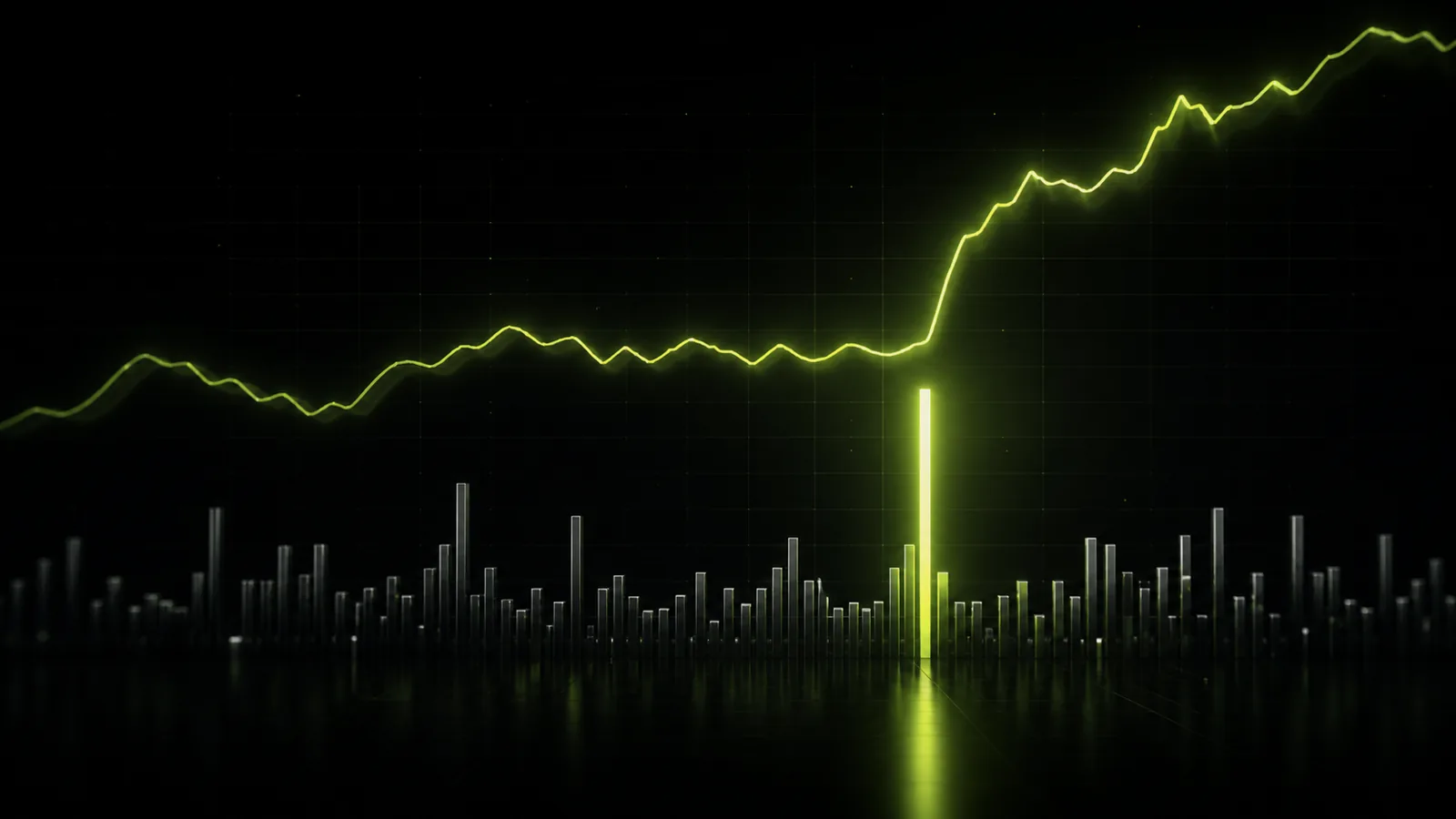
A price line moves above volume bars with one tall surge bar below it
Delta-X Academy

Volume: The Basics

Original Delta-X illustration.
free8 min read

Volume is the number of contracts or shares traded in a period, usually drawn as bars beneath price. It measures participation, not direction: a large volume bar tells you many traders were active during that candle, which adds weight to whatever the price did.

Target audience: Traders who read price alone and want a simple, honest way to gauge conviction behind a move.

Learning objectives

  • Explain what volume measures and what it does not.
  • Use volume to gauge conviction behind a move or a breakout.
  • Recognise that volume is confirmation, not a standalone signal.
  • Understand where volume is reliable and where it is not.

Definition

Volume is the number of contracts or shares traded in a period, usually drawn as bars beneath price. It measures participation, not direction: a large volume bar tells you many traders were active during that candle, which adds weight to whatever the price did.

Why it matters

Price tells you what happened and volume tells you how much conviction was behind it, so the two read together filter moves that look identical on price alone. A breakout on heavy volume and one on thin volume are very different events, and a trader who ignores participation treats them the same and gets caught by the hollow one.

Participation, not direction

Every trade has a buyer and a seller, so volume cannot by itself say which side won; it only counts how much trading occurred. A tall volume bar means many participants were active in that period, which makes the price action more significant whether it rose or fell. Volume is therefore a weighting on price, not a separate signal. The mistake is to read a big volume bar as bullish or bearish on its own, when its meaning depends entirely on what price did alongside it.

Conviction behind a move

A strong move on rising volume suggests broad participation and conviction, because many traders are pushing in the same direction. A move on falling or thin volume suggests the opposite: few participants and a move that may not hold. The classic application is the breakout. A break of resistance on a clear surge of volume is more likely to stick than the same break on quiet volume, where the move is more easily faded. Volume does not confirm direction, but it gauges how much weight to give the move.

Where volume is and is not reliable

Volume is most useful on centralised markets such as futures and stocks, where the reported figure reflects the whole market. On decentralised markets such as spot foreign exchange, the volume on your chart is only your broker's slice and can mislead. Volume also has daily and weekly seasonality: the open and close are naturally busier than midday, and holidays are thin. Read volume relative to its own recent normal for that time of day, not as an absolute number, and be sceptical of it where the data is only a fragment of the market.

Visual models

Volume profile: POC, value area, high-volume acceptance and low-volume rejection
Volume profile chartA horizontal volume-by-price distribution highlights the point of control, the seventy percent value area between VAH and VAL, high-volume nodes, and low-volume nodes.0355710106514201962.002401961.002801960.004201959.005201958.007601957.001,2801956.001,4201955.001,1801954.008601953.006001952.003601951.001901950.002501949.00280VAH 1958VAL 1953POC 1956~70% volume in valuePOCHVNLVNpricevolume traded at price

Worked examples

Example 1: Two identical breakouts, different volume

A stock breaks a well-watched 80 resistance twice in a month. The first break comes on volume three times the recent average, and the move holds and extends. The second break looks identical on price but comes on below-average volume, and it fails within two candles. Price alone could not separate them. Volume could: the first had broad participation behind it, the second was a hollow push that few traders supported, and the difference showed up in the volume bars.

Common mistakes

Reading a large volume bar as bullish or bearish on its own.

Comparing volume across times of day without accounting for seasonality.

Trusting spot foreign-exchange volume as if it were whole-market data.

Using volume as a standalone entry signal rather than confirmation.

Ignoring volume entirely and treating a thin breakout like a strong one.

Myth vs reality

Myth

That volume tells you the direction the market is going.

Reality

No paired reality note provided.

Myth

That a high absolute volume number is always significant.

Reality

No paired reality note provided.

Myth

That broker-reported volume reflects the entire market everywhere.

Reality

No paired reality note provided.

Risk considerations

  • Volume confirms conviction but never guarantees a move continues.
  • Misreading fragmentary volume data can give false confidence in a breakout.

Practice exercises

1. Read volume on three breakouts

Find three breakouts and judge each using the volume that accompanied the breakout candle.

  1. For each breakout, compare the volume bar to the recent average for that time of day.
  2. Label the participation as heavy, average, or thin.
  3. Check whether the heavier-volume breaks held better than the thin ones.
  4. Note one case where volume changed your read of an otherwise identical break.

Quiz

Q1. What does volume measure?

Q2. How does volume help read a breakout?

Q3. Why is spot foreign-exchange volume less reliable?

Next lesson

Moving Averages

Continue to next

This lesson is educational content only and is not financial advice. Charts and indicators describe what price has already done; they do not predict the future or guarantee any outcome. No indicator works in every market or timeframe. Trading involves substantial risk, and you should trade only with risk you can afford to lose.