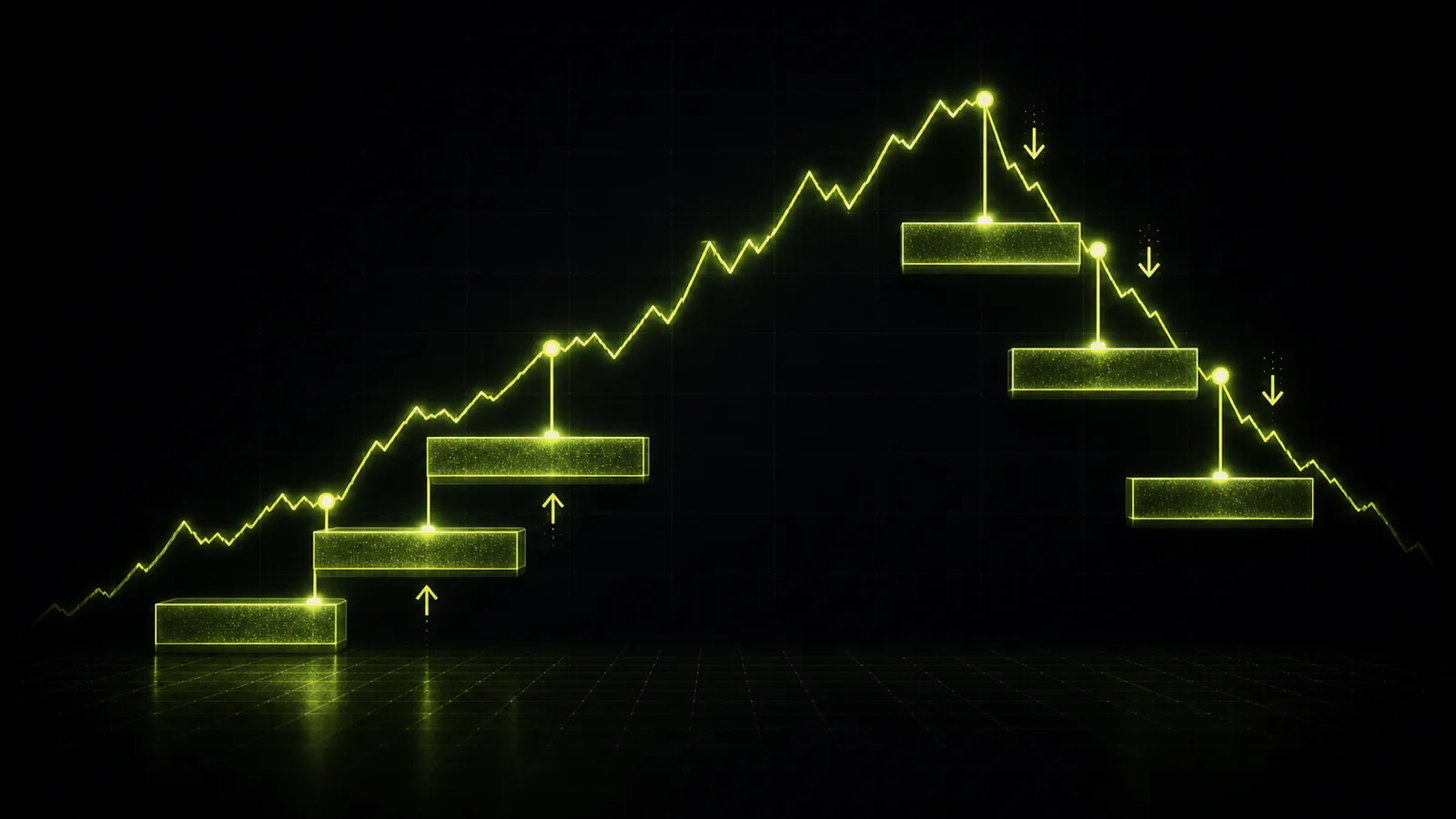
A position builds and unwinds in stepped lime blocks
Delta-X Academy

Scaling In and Scaling Out

Original Delta-X illustration.
free9 min read

Scaling is entering or exiting a position in pieces rather than all at once. Scaling in builds the position across several prices; scaling out takes partial profits or reduces risk in stages. Both trade a single perfect decision for a smoother average and more flexibility, with their own costs.

Target audience: Traders who go all-in and all-out at one price and want a more flexible approach.

Learning objectives

  • Define scaling in and scaling out.
  • Explain how scaling spreads timing risk.
  • Distinguish healthy scaling from averaging into a loser.
  • Plan scale levels in advance rather than improvising.

Definition

Scaling is entering or exiting a position in pieces rather than all at once. Scaling in builds the position across several prices; scaling out takes partial profits or reduces risk in stages. Both trade a single perfect decision for a smoother average and more flexibility, with their own costs.

Why it matters

All-at-once entries and exits demand you pick the perfect price, which no one does reliably. Scaling spreads that timing risk and lets you bank profit while staying in a move, which is why many professionals trade in pieces. But scaling has real traps, especially averaging into a loser, and using it without rules turns a tool for managing risk into a way of feeding it.

Building and reducing in pieces

Scaling in means entering a planned position over several prices rather than in one fill: a first piece at your level, more if price offers a better one within your plan. Scaling out is the reverse on the way out: taking part of the position off at a first target, more at a second, leaving a remainder to run. Both replace a single all-or-nothing decision with a sequence, which smooths your average price and lets you adjust as the trade develops instead of betting everything on one moment of timing.

Spreading timing risk

The case for scaling is that nobody reliably picks the exact turn. Scaling into a zone rather than a single price gives a blended entry that does not depend on nailing the low, and scaling out banks real profit at the first target so a winner cannot turn into a full loser, while leaving something on to capture a larger move. This is why scaling out in particular suits traders who struggle to hold winners: it resolves the tension between taking profit and letting it run by doing some of each.

The trap: averaging into a loser

Scaling in is healthy only when adding is part of the original plan at prices that still respect your invalidation. It becomes dangerous the moment it turns into averaging down: adding to a losing position simply because it is cheaper now, moving your stop further away to accommodate the bigger size, and converting a small planned loss into a large unplanned one. The discipline is that every scale level and the final stop are decided before entry. If adding requires moving the stop, it is not scaling, it is hoping.

Visual models

Range structure: the edges hold the edge, the midpoint is no-edge chop
Range structure mapPrice oscillates between a range high acting as supply and a range low acting as demand, reacting at each edge while the midpoint offers no edge and produces chop.range high: fade shortrange low: fade longmidpoint: no edge255180midsupplydemandchoppricetrade the edges, not the middle
Range structure: the edges hold the edge, the midpoint is no-edge chop
Range structure mapPrice oscillates between a range high acting as supply and a range low acting as demand, reacting at each edge while the midpoint offers no edge and produces chop.range high: fade shortrange low: fade longmidpoint: no edge255180midsupplydemandchoppricetrade the edges, not the middle

Worked examples

Example 1: Scaling out of a winner

A trader enters a long with a plan to scale out across a range. At the first resistance they sell a third, banking profit and reducing risk; at the next level they sell another third; the final third they let run with the stop moved to breakeven. Price stalls and pulls back, but the trader has already locked most of the gain and the remaining piece costs nothing if it fails. They captured most of a move without needing to predict its exact top, which a single all-at-once exit would have forced them to guess.

Common mistakes

Averaging down into a loser and calling it scaling in.

Moving the stop further away to fit an added position.

Improvising scale levels instead of planning them before entry.

Scaling out so aggressively that winners never amount to anything.

Adding size with no rule for where the whole position is wrong.

Myth vs reality

Myth

That adding to a losing trade is the same as scaling in.

Reality

No paired reality note provided.

Myth

That scaling out always beats holding the full position.

Reality

No paired reality note provided.

Myth

That you can decide scale levels in the heat of the trade.

Reality

No paired reality note provided.

Risk considerations

  • Averaging into a loser can turn a small planned loss into a large one.
  • A pre-set final stop for the whole position must survive every scale-in.

Practice exercises

1. Write a scaling plan

For one trade idea, plan the scale-in and scale-out levels before entering.

  1. Define the first entry and any additional scale-in prices within your plan.
  2. Set the single stop for the whole position and confirm it never moves.
  3. Choose the partial-profit levels for scaling out.
  4. Check that even fully scaled in, the position risks only your set amount.

Quiz

Q1. What is the difference between scaling in and scaling out?

Q2. How does scaling out help a trader who cannot hold winners?

Q3. When does scaling in become dangerous?

Next lesson

Stop Hunts and Liquidity Sweeps

Continue to next

This lesson is educational content only and is not financial advice. Order types, fees, and execution behaviour vary by broker, venue, and market; always read your own platform's documentation. Trading involves substantial risk, and good execution cannot turn a losing strategy into a winning one. Trade only with risk you can afford to lose.