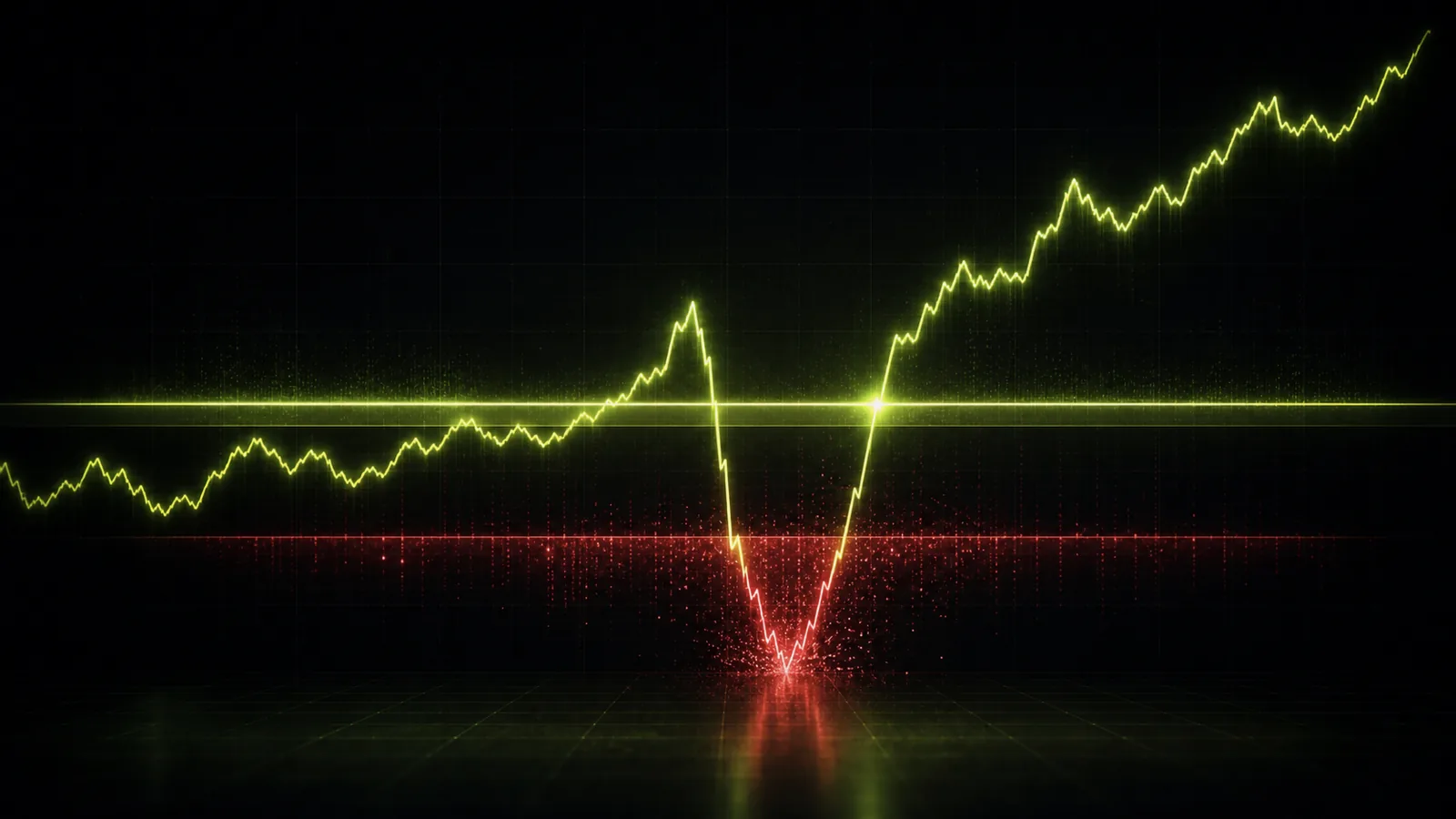
Price sweeps clustered stops below a level and then reverses
Delta-X Academy

Stop Hunts and Liquidity Sweeps

Original Delta-X illustration.
free9 min read

A liquidity sweep, or stop hunt, is a sharp move that pushes price just past an obvious level where stop orders cluster, triggering them, and then reverses. The clustered stops are a pool of liquidity; running them, whether by deliberate targeting or simply because that is where resting orders sit, lets other participants fill against the orders those stops release. It does not always reverse, so it needs confirmation, not assumption.

Target audience: Traders who keep getting stopped out at the extreme just before the move they predicted.

Learning objectives

  • Explain why stops cluster at obvious levels.
  • Describe how a liquidity sweep triggers and then reverses.
  • Recognise a sweep and failed break in real time.
  • Place stops beyond the sweep rather than inside it.

Definition

A liquidity sweep, or stop hunt, is a sharp move that pushes price just past an obvious level where stop orders cluster, triggering them, and then reverses. The clustered stops are a pool of liquidity; running them, whether by deliberate targeting or simply because that is where resting orders sit, lets other participants fill against the orders those stops release. It does not always reverse, so it needs confirmation, not assumption.

Why it matters

Few things are more demoralising than being stopped out at the exact low before price rockets the way you expected. Understanding that obvious levels are pools of stop liquidity, and that price is often drawn to run them before reversing, changes where you place your own stop. It turns a recurring, baffling loss into a predictable behaviour you can position beyond instead of feeding.

Obvious levels are pools of stops

Stops cluster where everyone can see they belong: just beyond a clear swing high or low, under a well-watched support, above an obvious resistance, around round numbers. Because so many traders place protective stops in the same obvious spots, those prices hold a dense pool of resting orders. A sell stop is an order to sell when triggered, so a cluster of sell stops below support is a cluster of sell orders waiting to fire, which is exactly the liquidity a large buyer would love to fill against.

Running the stops, then sometimes reversing

When price reaches that pool, it pushes just past the obvious level, often on a sharp spike, and triggers the clustered stops. Those triggered stops release a burst of orders that can fuel the spike, and with the stops cleared and the weak holders out, price often reverses back through the level and resumes the original way. This need not be a deliberate hunt; obvious levels are simply where stops pile up, and ordinary volatility runs them. The tell is the shape, a quick poke beyond the level that does not hold, leaving a long wick and a close back inside. But a genuine breakout also begins with a move beyond the level, so the poke is only a sweep once it fails and closes back inside, not before.

Positioning beyond the sweep

You cannot stop the market from sweeping liquidity, but you can avoid donating your stop to the pool. Place protective stops beyond the obvious level and beyond the typical reach of a sweep, not at the exact spot every other trader chose, and accept the slightly wider stop with smaller size. Treat a sweep and reversal as information rather than noise: a failed break that runs the stops and closes back inside is often a higher-quality entry in the original direction than the obvious breakout was.

Visual models

Breakouts and fakeouts: a real break retests and holds; a fakeout pokes the level and reclaims back inside
Breakout versus fakeoutThe left panel shows a genuine breakout that pulls back, retests the broken level as support, and continues. The right panel shows a fakeout that pierces the level on a wick and closes back inside, trapping breakout buyers.level 225break1retest holds2real breaklevel 225false break1reclaim: trap2fakeoutconfirm the break with a held retest, not a single poke
Breakouts and fakeouts: a real break retests and holds; a fakeout pokes the level and reclaims back inside
Breakout versus fakeoutThe left panel shows a genuine breakout that pulls back, retests the broken level as support, and continues. The right panel shows a fakeout that pierces the level on a wick and closes back inside, trapping breakout buyers.level 225break1retest holds2real breaklevel 225false break1reclaim: trap2fakeoutconfirm the break with a held retest, not a single poke

Worked examples

Example 1: The sweep below support

Support sits at a round number that has held twice, and stops are stacked just below it. On the third test, price spikes a few ticks under the level, triggers the stops, and the wick prints well below before snapping back to close above the level. Traders who set stops at the obvious spot were sold out at the low; price then turns up and runs. A trader who placed their stop further below, beyond the sweep, survived the spike and is still in the move that the sweep would otherwise have shaken them out of.

Common mistakes

Placing stops at the exact obvious level where everyone else does.

Treating a quick poke beyond a level as a real breakout.

Getting shaken out by a sweep and not re-engaging on the reversal.

Ignoring that round numbers and swing extremes hold stop pools.

Using a tight stop at an obvious spot with full size.

Myth vs reality

Myth

That a spike beyond a level always means the level has broken.

Reality

No paired reality note provided.

Myth

That stops placed at the obvious level are safe there.

Reality

No paired reality note provided.

Myth

That being stopped at the low was bad luck rather than predictable.

Reality

No paired reality note provided.

Risk considerations

  • A stop beyond the sweep is wider, so size must come down to hold risk constant.
  • Not every sweep reverses; a genuine break can follow, so confirmation still matters.

Practice exercises

1. Spot the sweeps on your chart

Find past liquidity sweeps and judge where a stop should have been.

  1. Mark obvious swing highs, lows, and round numbers on a chart.
  2. Find places where price poked just beyond one, then reversed and closed back inside.
  3. Note where a crowd stop would have sat and where it got run.
  4. Decide where a stop beyond the sweep would have survived.

Quiz

Q1. Why do stops cluster at obvious levels?

Q2. What is the tell of a liquidity sweep versus a real break?

Q3. How should you place a stop to avoid feeding a sweep?

Path complete

You have reached the end of this path

Nice work finishing the path. Revisit any lesson to reinforce it, or explore another path in the academy.

Back to the academy

This lesson is educational content only and is not financial advice. Order types, fees, and execution behaviour vary by broker, venue, and market; always read your own platform's documentation. Trading involves substantial risk, and good execution cannot turn a losing strategy into a winning one. Trade only with risk you can afford to lose.