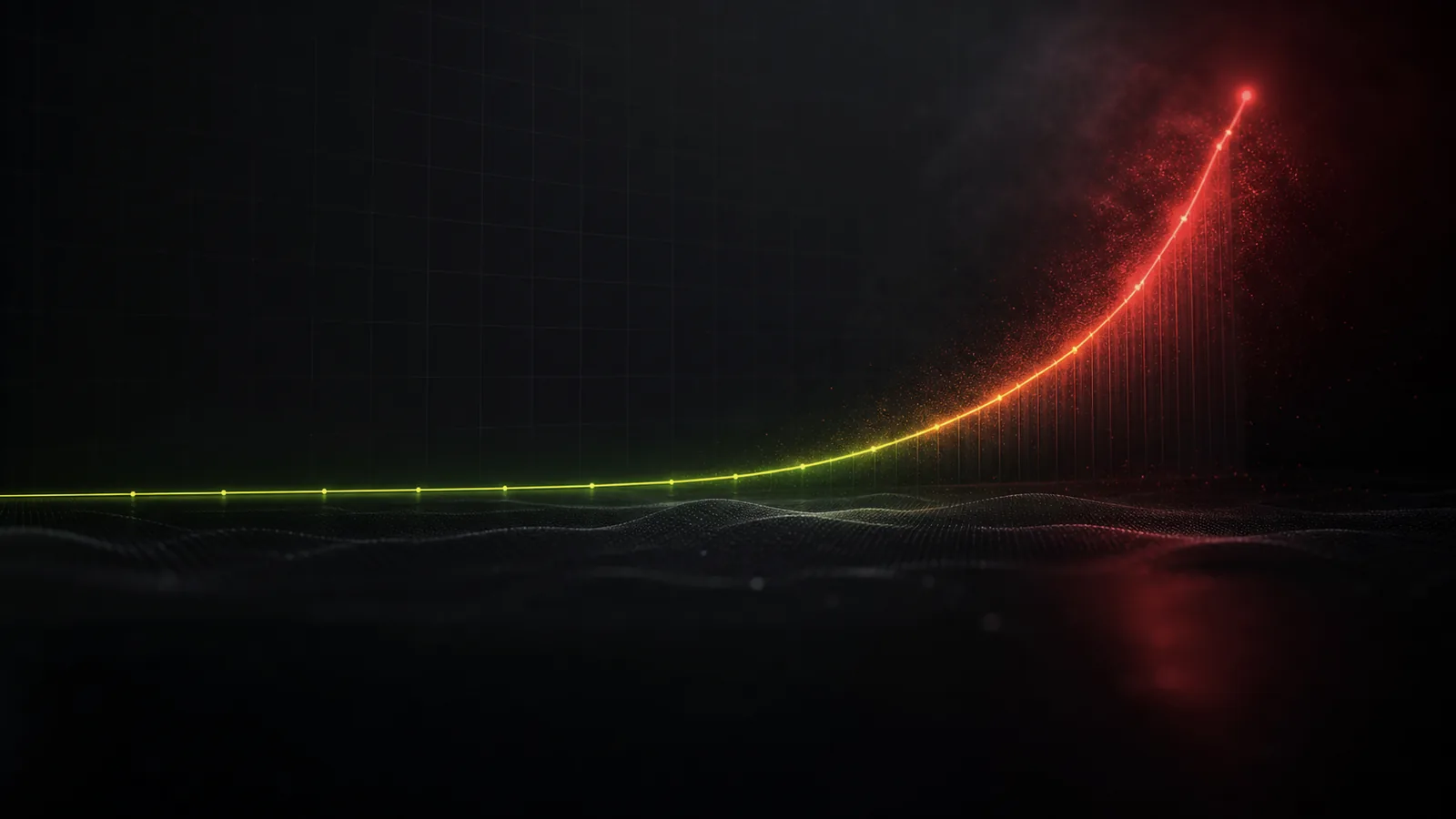
A ruin curve rises sharply as bet size grows beyond the safe zone
Delta-X Academy

Risk of Ruin: What Busts Accounts

Original Delta-X illustration.
free10 min read

Risk of ruin is the probability that a series of trades eventually drops your account to a chosen ruin level. It rises sharply with the fraction risked per trade and falls with a larger edge, a higher win rate, and more units of capital between you and ruin. Even a positive-edge strategy can have a meaningful risk of ruin if the bets are too large.

Target audience: Traders who believe a positive expectancy alone protects them from blowing up.

Learning objectives

  • Define risk of ruin and what it depends on.
  • Explain why a positive edge can still carry ruin risk.
  • Show how bet size dominates risk of ruin.
  • Use an illustrative model within its stated assumptions.

Definition

Risk of ruin is the probability that a series of trades eventually drops your account to a chosen ruin level. It rises sharply with the fraction risked per trade and falls with a larger edge, a higher win rate, and more units of capital between you and ruin. Even a positive-edge strategy can have a meaningful risk of ruin if the bets are too large.

Why it matters

Traders assume a positive edge makes them safe, but a profitable strategy bet too aggressively still has a real chance of busting before the edge plays out. Risk of ruin makes the link between bet size and survival explicit and shows that the single most powerful lever you control, far more than small tweaks to the edge, is simply how much you risk per trade.

What risk of ruin depends on

Risk of ruin is the chance that your equity eventually falls to a level you define as ruin. It moves with a few inputs. It rises as you risk a larger fraction per trade, because bigger bets reach ruin faster. It falls as your edge and win rate improve, because you lose less often and less far. And it falls as you hold more units of capital between your starting point and ruin, because there is more cushion to absorb a bad run. Of these, the fraction risked per trade is the one you control most directly and the one that moves the number most.

A positive edge is not safety

It is a common and dangerous belief that a profitable strategy cannot blow up. It can. A positive edge tilts the long-run average in your favour, but it does not stop a bad run from reaching ruin first if each bet is large. Expectancy describes where you end up after many trades; risk of ruin describes whether you survive the path to get there. The two are different questions. You can have a genuinely positive edge and still carry a real probability of busting, purely because the bets are sized too big to outlast a normal losing sequence.

An illustrative model, and its limits

A simple model makes the bet-size effect concrete. In an even-money game where you risk one unit to win one with win probability p above one half, the probability of eventually losing a bankroll of U units is the ratio of the loss probability to the win probability, raised to the power U. With a fifty-five percent win rate and twenty units of bankroll, meaning each bet risks one twentieth, this is about two percent. Cut the bankroll to ten units, meaning each bet risks one tenth, and it jumps to about thirteen percent. Real trading has variable win and loss sizes, so this exact formula does not apply, but the lesson it shows, that halving your bet size can cut ruin risk many times over, holds far more generally.

Visual models

Risk of ruin (illustrative shape, not a formula): capping bet size, not just having an edge, keeps ruin near zero
Risk of ruin versus risk per tradeAn illustrative shape, not a formula: the probability of eventually ruining the account stays near zero while the bet per trade is small and then rises steeply as the bet grows. The exact numbers depend on the edge, win rate, and number of trades, so only the shape is shown.highlow0%2%4%6%8%10%small bet: ruin near zerolarger bet: ruin creeps upbig bet: ruin climbs steeplytoo big: ruin dominates the long runsafe zonerisk of ruinrisk per trade (illustrative)

Worked examples

Example 1: Same edge, bet size decides ruin

Take an even-money edge with a fifty-five percent win rate. Risking one twentieth of the account per bet, so twenty units stand between you and ruin, the risk of ruin is about two percent, the ratio nine over eleven raised to the twentieth power. Now double the bet to one tenth, leaving ten units, and the same edge gives a risk of ruin of about thirteen percent, that ratio to the tenth power. The edge did not change at all; only the bet size did, and the chance of busting grew more than sixfold. Bet size, not the edge, was the dominant lever over survival.

Common mistakes

Believing a positive edge removes the chance of ruin.

Confusing long-run expectancy with surviving the path to it.

Tweaking the edge for safety instead of cutting bet size.

Applying the even-money ruin formula to variable-size trades as if exact.

Risking a large fraction per trade and assuming a good run will come first.

Myth vs reality

Myth

That profitability and safety from ruin are the same thing.

Reality

No paired reality note provided.

Myth

That a positive expectancy guarantees survival.

Reality

No paired reality note provided.

Myth

That the simple ruin formula applies exactly to real trading.

Reality

No paired reality note provided.

Risk considerations

  • Bet size is the dominant and most controllable driver of risk of ruin.
  • The clean formula assumes even-money, fixed bets and independent trades; real trading differs.

Practice exercises

1. Feel the bet-size lever

Use the even-money model to see how bet size dominates ruin risk.

  1. Pick a win rate above one half for an even-money game.
  2. Compute the ruin probability for a bankroll of twenty units (risking one twentieth).
  3. Recompute for ten units (risking one tenth) and compare.
  4. Note how much ruin risk falls when you halve the bet, then relate it to your own sizing.

Quiz

Q1. What does risk of ruin depend on?

Q2. Can a positive-edge strategy still have meaningful risk of ruin?

Q3. In the even-money model, what does halving the bet do to ruin risk?

Next lesson

The Kelly Criterion

Continue to next

This lesson is educational content only and is not financial advice. The formulas here are models that rely on stated assumptions (such as a known, fixed edge and independent trades); real markets violate those assumptions, so treat the numbers as intuition, not guarantees. Trading involves substantial risk of loss, and no sizing method removes it. Trade only with risk you can afford to lose.