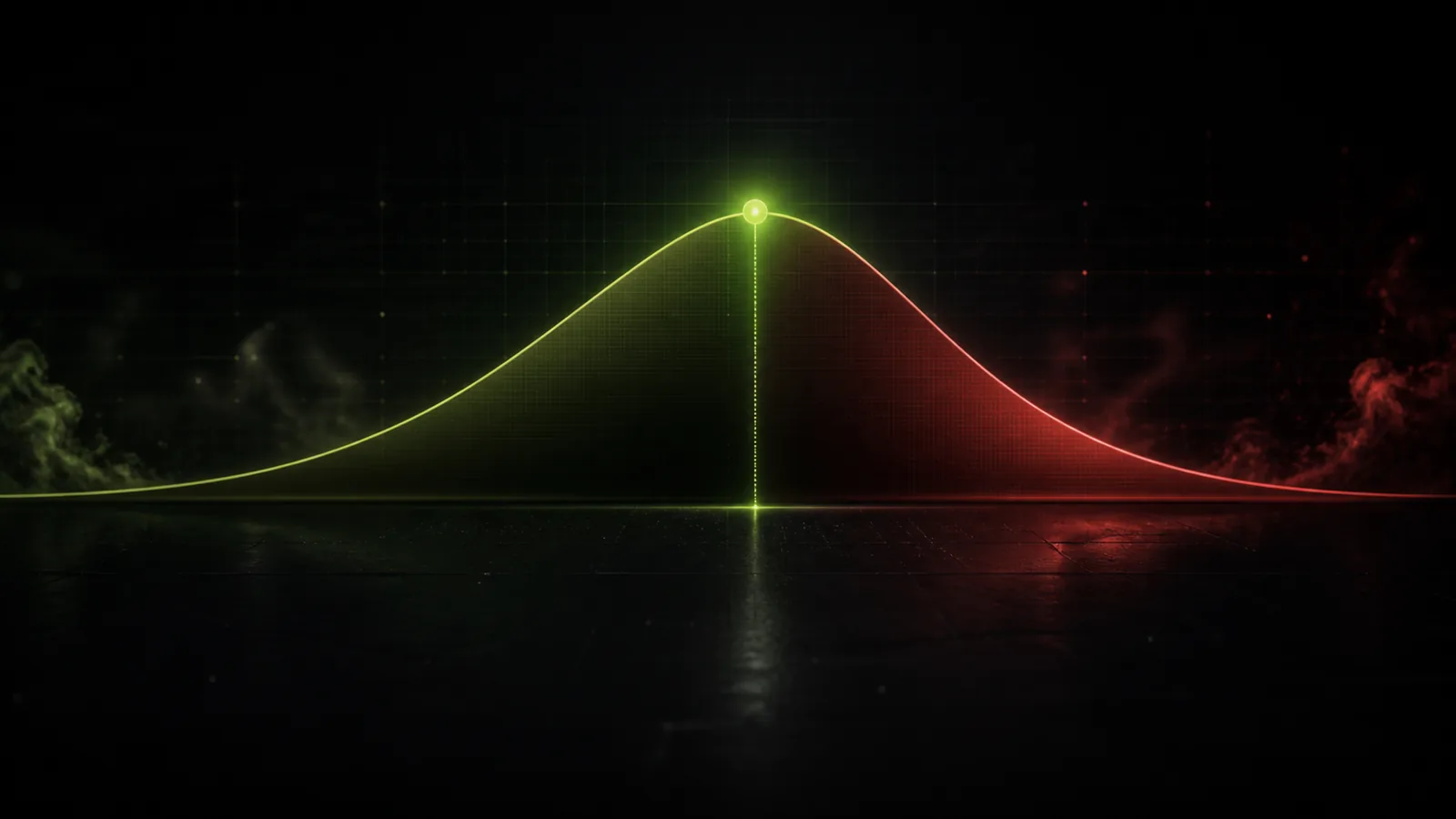
A growth curve peaks at the optimal bet size and falls as risk is pushed too far
Delta-X Academy

The Kelly Criterion

Original Delta-X illustration.
free9 min read

The Kelly criterion gives the bet fraction that maximises the long-run growth rate of capital. For a trade that wins a fraction W of the time with a reward-to-risk ratio R, the Kelly fraction is W minus the quantity one minus W divided by R. It is growth-optimal in theory, but it prescribes large, highly volatile bets.

Target audience: Traders who want a principled answer to how much to risk and a reference for over-betting.

Learning objectives

  • State the Kelly fraction for a trade with win rate and reward-to-risk.
  • Explain that Kelly maximises long-run growth.
  • Show that over-betting Kelly lowers growth and raises risk.
  • Recognise why the Kelly bet is impractically large.

Definition

The Kelly criterion gives the bet fraction that maximises the long-run growth rate of capital. For a trade that wins a fraction W of the time with a reward-to-risk ratio R, the Kelly fraction is W minus the quantity one minus W divided by R. It is growth-optimal in theory, but it prescribes large, highly volatile bets.

Why it matters

Kelly is the rigorous answer to how much is too much: bet more than Kelly and your long-run growth actually falls while your risk climbs, so Kelly marks a ceiling, not a target. Understanding it gives you a principled reference point for sizing and, crucially, shows why the optimal-for-growth bet is far larger than any sane trader would actually risk.

The growth-optimal fraction

The Kelly criterion answers a precise question: what fraction of your capital, bet repeatedly, maximises the long-run compound growth rate. For a trade that wins with probability W and pays a reward-to-risk ratio R, meaning you win R times your risk on a win and lose your risk on a loss, the Kelly fraction is W minus one minus W divided by R. If the result is zero or negative, the math is telling you there is no edge to bet on. Kelly is not a rule of thumb; it is the exact growth-maximising answer under its assumptions.

A ceiling, not a target

The key property of Kelly is that growth is maximised at the Kelly fraction and falls off on either side. Bet less than Kelly and you grow more slowly but more smoothly. Bet more than Kelly and you do not grow faster; you grow slower while taking dramatically more risk, and far enough past it your expected growth turns negative even with a positive edge. This makes Kelly a ceiling. Over-betting is not aggression rewarded with more return; it is strictly worse on both axes, which is one of the most useful and counterintuitive facts in sizing.

Optimal but violent

The catch is that the Kelly fraction is large and the ride is brutal. A coin-flip edge that wins half the time at a two-to-one reward-to-risk gives a Kelly fraction of one quarter, meaning risk twenty-five percent of the account per trade. Betting that much produces enormous swings, with drawdowns of fifty percent or more occurring routinely along the optimal-growth path. Real edges are smaller and uncertain, and you never know W and R exactly, so betting full Kelly on an estimated edge means betting full Kelly on a number that might be wrong, which is how the optimal bet becomes a dangerous one.

Worked examples

Example 1: Working the Kelly fraction

Take a strategy that wins half the time with a two-to-one reward-to-risk. Kelly is W minus one minus W over R, which is one half minus one half divided by two, equal to one quarter, so the growth-optimal bet is twenty-five percent of capital per trade. A different strategy that wins forty percent of the time at the same two-to-one gives nought point four minus nought point six over two, which is nought point four minus nought point three, equal to nought point one, or ten percent per trade. Both numbers are far larger than any prudent trader risks, which is exactly why the next lesson is about betting a fraction of Kelly.

Common mistakes

Treating the Kelly fraction as a target to hit rather than a ceiling.

Believing betting past Kelly increases growth.

Betting full Kelly on an estimated, uncertain edge.

Forgetting Kelly assumes you know the true win rate and payoff.

Ignoring the severe drawdowns that full Kelly produces.

Myth vs reality

Myth

That more than Kelly means faster growth.

Reality

No paired reality note provided.

Myth

That the Kelly fraction is a sensible amount to actually risk.

Reality

No paired reality note provided.

Myth

That Kelly works when the edge is unknown or unstable.

Reality

No paired reality note provided.

Risk considerations

  • Full Kelly produces routine deep drawdowns even when correct.
  • Betting Kelly on an overestimated edge silently means over-betting.

Practice exercises

1. Compute Kelly for your edge

Work out the Kelly fraction for strategies you trade and judge its size.

  1. Estimate the win rate W and reward-to-risk R for a strategy.
  2. Compute W minus one minus W divided by R.
  3. Compare the result to the fraction you actually risk per trade.
  4. Note how far below full Kelly your real sizing sits, and why that is sane.

Quiz

Q1. What is the Kelly fraction for a trade with win rate W and reward-to-risk R?

Q2. Why is Kelly a ceiling rather than a target?

Q3. Why is the full Kelly bet impractical?

Next lesson

Why Professionals Trade Fractional Kelly

Continue to next

This lesson is educational content only and is not financial advice. The formulas here are models that rely on stated assumptions (such as a known, fixed edge and independent trades); real markets violate those assumptions, so treat the numbers as intuition, not guarantees. Trading involves substantial risk of loss, and no sizing method removes it. Trade only with risk you can afford to lose.