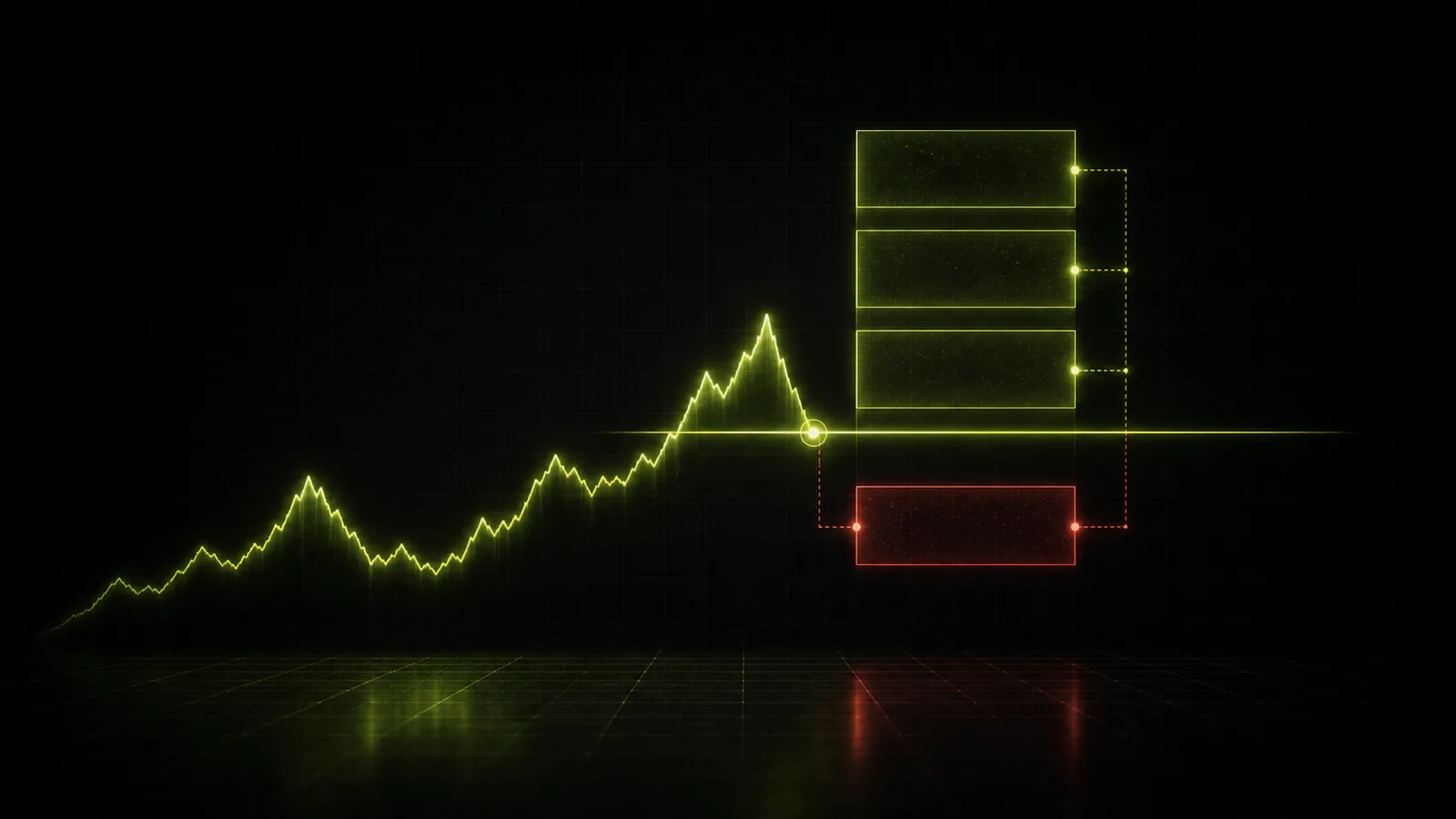
A lime entry line sits above a measured red risk unit repeated as multiples
Delta-X Academy

Defining Your Risk: The One-R Unit

Original Delta-X illustration.
free9 min read

One R is the amount you risk on a trade: the distance from your entry to your initial stop, multiplied by your position size. Every result is then measured in multiples of that unit, so a full stop is minus one R and a win of twice your risk is plus two R, regardless of the dollar amounts.

Target audience: Traders who track profit and loss only in dollars and cannot compare trades of different sizes.

Learning objectives

  • Define one R as a trade's initial risk.
  • Express any outcome as a multiple of R.
  • Explain why R normalises trades of different sizes.
  • Use R as the unit for evaluating a strategy.

Definition

One R is the amount you risk on a trade: the distance from your entry to your initial stop, multiplied by your position size. Every result is then measured in multiples of that unit, so a full stop is minus one R and a win of twice your risk is plus two R, regardless of the dollar amounts.

Why it matters

Thinking in dollars ties your judgement to account size and makes trades of different sizes impossible to compare. Thinking in R normalises everything: it lets you evaluate a strategy by the distribution of its R outcomes, separates the quality of a trade from how much money was on it, and is the common language behind reward-to-risk, expectancy, and almost every other management idea in this path.

R is your risk unit

One R is simply what you stand to lose if the trade hits its initial stop: the distance from entry to stop in price, times the size of the position. If you buy at 100 with a stop at 98 and hold a size where each point is worth ten dollars, your R is twenty dollars. R is fixed at entry by your stop and size, and it is the natural unit of the trade. Everything that happens next can be described as some multiple of that one number.

Every outcome in multiples of R

Once R is defined, results stop being raw dollars and become R multiples. Getting stopped at the initial stop is minus one R. Closing at twice your risk distance is plus two R. A trade cut for a small loss before the stop might be minus a third of an R. This is powerful because it strips out account size and position size: a plus two R trade is the same quality whether you risked twenty dollars or two thousand. You can now talk about a trade's result as a property of the trade, not of your bankroll.

Judging a strategy in R

Because R is comparable across trades, the record of a strategy becomes a distribution of R multiples: so many minus-one-R losers, some small winners, a few large plus-three-R or plus-five-R winners. That distribution is what tells you whether the strategy has an edge, through its expectancy, far more clearly than a dollar profit-and-loss that mixes in every change of size. Tracking trades in R is the foundation the later lessons on reward-to-risk, partial profits, and letting winners run all build on.

Visual models

R-multiple sequence: normal losses stay survivable until risk is oversized
R-multiple loss sequenceThe cumulative R curve falls gradually during planned losses, then drops sharply when two pressure trades exceed the one R rule before the reset stabilizes it.+3.0R0.0R-1.0R-3.0R-6.0R+0.8R-1.0R+1.4R-0.9R-1.0R-1.0R-1.8R-2.6R+0.2R+0.9R+1.3R-1R planned risk cappressure trades2 breaks = -4.4Rcumulative Rtrade outcome

Worked examples

Example 1: Same R, different dollars

Trader A risks twenty dollars on a trade and makes sixty; trader B risks two thousand on another and makes six thousand. In dollars they look incomparable, but both made plus three R: each made three times what they risked. If you only saw the dollars you might think B traded far better, when in R terms the two trades were identical in quality. Measuring in R is what lets you see that, and lets a single trader compare a small probe to a full-size position on the same scale.

Max-loss budget by position-size risk: convert account risk into a hard maximum loss before sizing
Max-loss budget chartA deterministic risk ladder shows dollar loss budgets and unit counts for several account-risk percentages using a fixed stop distance.$0$500$1,000$1,500$2,000$2500.25%$5000.5%$7500.75%$1,0001%$1,2501.25%$1,5001.5%$2,0002%1% reference: $1,000Sizing formula$100,000 x 1% = $1,000$1,000 / $1.25 stop = 800 unitsmaximum dollar lossaccount risk percentage

Common mistakes

Tracking only dollar profit and loss, so trades of different sizes cannot compare.

Letting R drift by moving the initial stop after entry.

Confusing a big dollar win with a good trade when the R multiple was small.

Sizing the position before the stop, so R is whatever is left over.

Ignoring small sub-one-R losses when reviewing the R distribution.

Myth vs reality

Myth

That a larger dollar profit always means a better trade.

Reality

No paired reality note provided.

Myth

That R can be defined without first fixing the stop.

Reality

No paired reality note provided.

Myth

That account size should change how good a trade looks.

Reality

No paired reality note provided.

Risk considerations

  • R is only meaningful if the initial stop is respected; moving it breaks the unit.
  • Slippage can make a realised loss slightly larger than the planned one R.

Practice exercises

1. Convert your trades to R

Take your last ten trades and re-express each result as a multiple of R.

  1. For each trade, compute one R as the entry-to-stop distance times size.
  2. Express the actual result as a multiple of that trade's R.
  3. List the ten outcomes as a row of R multiples.
  4. Note how the R view changes which trades look best versus the dollar view.

Quiz

Q1. What is one R?

Q2. Why express outcomes in R instead of dollars?

Q3. What does a strategy's distribution of R multiples tell you?

Next lesson

The Reward-to-Risk Ratio

Continue to next

This lesson is educational content only and is not financial advice. No entry, exit, or trade-management rule works in every market or every trade; the right choice depends on your strategy, timeframe, and the conditions at the time. Trading involves substantial risk, and disciplined management cannot make a negative-edge strategy profitable. Trade only with risk you can afford to lose.