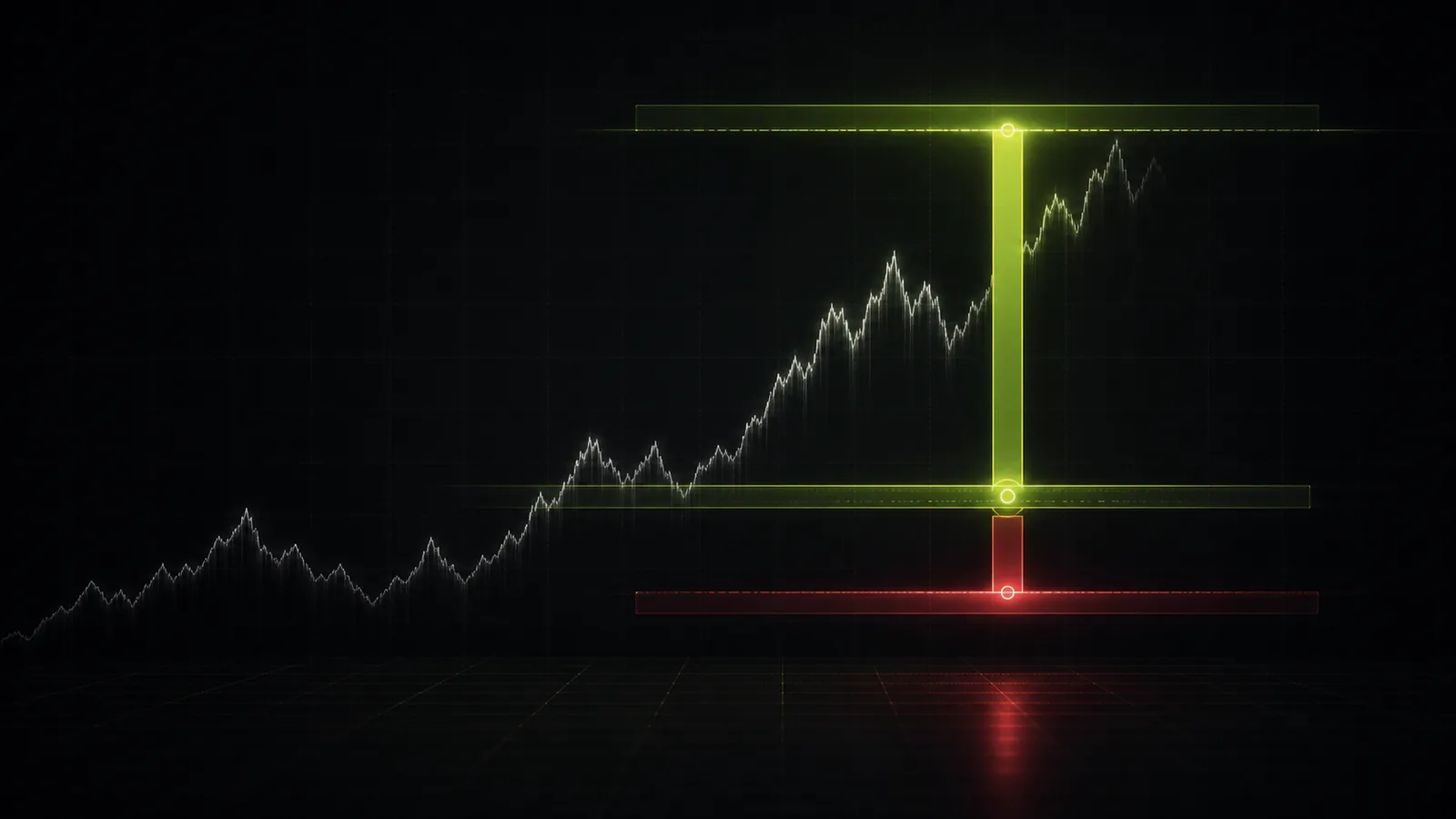
A short red risk bar is weighed against a taller lime reward bar
Delta-X Academy

The Reward-to-Risk Ratio

Original Delta-X illustration.
free8 min read

The reward-to-risk ratio compares a trade's potential reward to the risk taken for it, measured in R: a target two R away from entry against a one-R stop is a two-to-one ratio. It sets the win rate you need to break even, but only matters if the target is realistically reachable.

Target audience: Traders who either take tiny targets or set unreachable ones without checking the odds.

Learning objectives

  • Define the reward-to-risk ratio in R terms.
  • Compute the breakeven win rate for a given ratio.
  • Weigh the ratio against the probability of reaching the target.
  • Avoid both timid and fantasy targets.

Definition

The reward-to-risk ratio compares a trade's potential reward to the risk taken for it, measured in R: a target two R away from entry against a one-R stop is a two-to-one ratio. It sets the win rate you need to break even, but only matters if the target is realistically reachable.

Why it matters

Reward-to-risk and win rate are two halves of the same coin, and traders who chase one while ignoring the other go broke. A high ratio lets you profit while losing most of your trades, but only if price actually reaches the target often enough. Understanding the link between the ratio and the breakeven win rate keeps you from both timid one-to-one trades and fantasy ten-to-one targets that never fill.

Reward measured against risk

The reward-to-risk ratio is the size of your target relative to your risk, both measured in R. If your stop is one R away and your target is two R away, the ratio is two to one: you stand to make twice what you are risking. A higher ratio means each winner pays for more losers. The ratio is decided when you place the trade, by where the target sits relative to the stop, and it is one of the few things about a trade you control completely in advance.

The breakeven win rate

Every ratio implies a win rate you must beat to come out ahead, ignoring costs. At one to one you need to win more than half your trades. At two to one you only need to win more than a third. At three to one, more than a quarter. The relationship is that the breakeven win rate is one divided by one plus the ratio. This is why a strategy can lose most of its trades and still make money: a high enough reward-to-risk means the occasional winner more than covers the frequent small losses.

The ratio is only as good as the target

A reward-to-risk ratio is meaningless if the target never gets hit. It is easy to manufacture a beautiful ten-to-one trade by setting a target ten R away, but if price almost never travels that far, the real win rate collapses below breakeven and the trade is a loser despite its lovely ratio. The honest version of the ratio weighs reward against the probability of reaching the target. A modest two-to-one that fills often can beat a fantasy ten-to-one that does not. Place targets where price can realistically go, at structure, not where the ratio looks best.

Worked examples

Example 1: Low win rate, still profitable

A trader takes three-to-one trades and wins only thirty-five percent of them. Over a hundred trades they lose sixty-five at minus one R each, for minus sixty-five R, and win thirty-five at plus three R each, for plus one hundred and five R. The net is plus forty R despite losing nearly two trades out of three. The same trader forced into one-to-one targets at that win rate would lose money. The reward-to-risk ratio, as long as the three-R target was realistically reachable, is what made a low win rate profitable.

Common mistakes

Setting a high ratio with a target price rarely reaches.

Taking one-to-one trades that need a high win rate to survive costs.

Ignoring the win rate the chosen ratio actually requires.

Placing the target where the ratio looks good instead of at structure.

Judging a single trade by its ratio rather than the strategy over many.

Myth vs reality

Myth

That a higher reward-to-risk ratio is always better.

Reality

No paired reality note provided.

Myth

That the ratio matters regardless of whether the target is reachable.

Reality

No paired reality note provided.

Myth

That a high ratio removes the need to track the win rate.

Reality

No paired reality note provided.

Risk considerations

  • An unreachable target turns a great-looking ratio into a losing strategy.
  • Costs raise the real breakeven win rate above the simple formula.

Practice exercises

1. Match ratio to reachability

For one setup, set a target from structure and check the win rate its ratio demands.

  1. Mark the stop and a target at a realistic structural level.
  2. Express the target distance as a reward-to-risk ratio against the stop.
  3. Compute the breakeven win rate as one divided by one plus the ratio.
  4. Judge honestly whether your setup beats that win rate often enough.

Quiz

Q1. What is the reward-to-risk ratio?

Q2. What is the breakeven win rate for a given ratio?

Q3. Why can a high ratio still lose money?

Next lesson

Writing the Trade Plan Before You Enter

Continue to next

This lesson is educational content only and is not financial advice. No entry, exit, or trade-management rule works in every market or every trade; the right choice depends on your strategy, timeframe, and the conditions at the time. Trading involves substantial risk, and disciplined management cannot make a negative-edge strategy profitable. Trade only with risk you can afford to lose.