reader10 min read

Walk-Forward and Out-of-Sample Testing

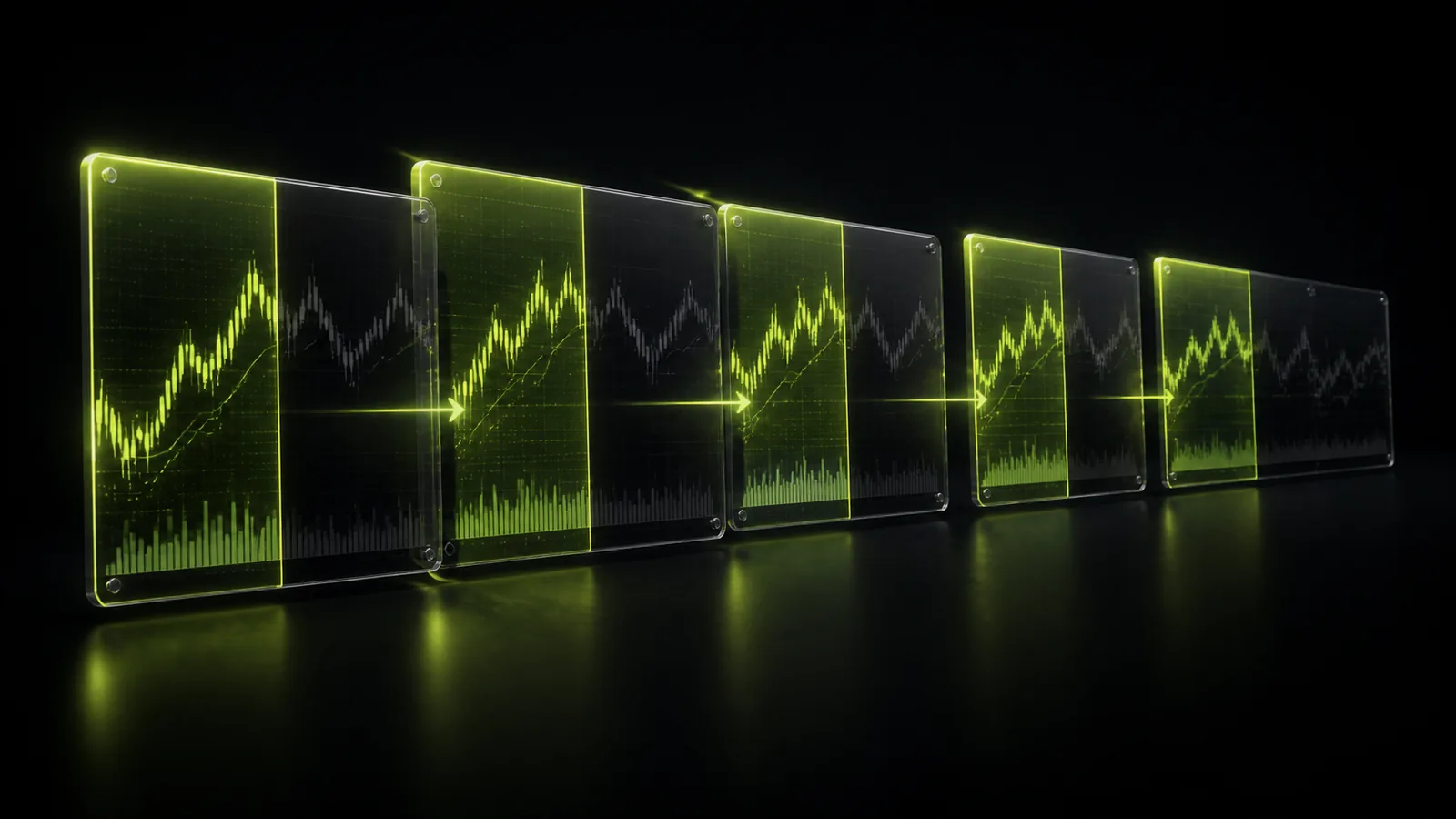
Out-of-sample testing measures a system on data it was never optimised on; walk-forward testing repeats this in rolling windows, optimising on one period and testing on the next, to estimate how the system performs on data it has not seen.

Target audience: Traders who optimise systems and want a validation method that resists curve-fitting.

Learning objectives

  • Split data into in-sample (training) and out-of-sample (validation) sets.
  • Run a rolling walk-forward: optimise on a window, test on the next.
  • Compare in-sample and out-of-sample performance to detect overfitting.
  • Treat out-of-sample degradation as the expected, not the exceptional, case.

Definition

Out-of-sample testing measures a system on data it was never optimised on; walk-forward testing repeats this in rolling windows, optimising on one period and testing on the next, to estimate how the system performs on data it has not seen.

Why it matters

In-sample results are the system graded on the answers it studied; out-of-sample results are the real exam. Walk-forward is the closest a backtest gets to honest live performance, because it forces the system to keep proving itself on fresh data. A strategy that holds up out-of-sample is far more likely to hold up with money.

Hold out data you never touch

The simplest defence against curve-fitting is to reserve a slice of history that you never look at while building the system. Develop and optimise only on the in-sample portion, then run the finished system once on the held-out out-of-sample data. If the edge survives, it is more likely real. The discipline is to look at the out-of-sample only once: every peek and tweak quietly turns it back into training data.

Walk it forward

A single hold-out uses only one slice of the future. Walk-forward does better: optimise on window 1, test on window 2; then roll forward, optimise on window 2, test on window 3; and so on. Stitching the test windows together gives an out-of-sample equity curve built entirely from data the system had not seen at each step. It mimics how you would actually re-tune and trade over time, and it spreads the validation across many market regimes.

Expect degradation

Out-of-sample results are almost always worse than in-sample; that gap is normal and informative. A small drop suggests a robust edge with some fitting; a large collapse to zero or negative says the in-sample result was mostly noise. Judge the system by its out-of-sample numbers, size for its out-of-sample drawdown, and never quote the in-sample figure as the expectation. The honest forecast is the exam grade, not the study-session grade.

Visual models

Drawdown recovery curve: the gain required accelerates as equity base shrinks
Drawdown recovery curveA convex recovery curve shows that small losses require modest gains, while deep drawdowns require dramatically larger gains on a reduced equity base.0%+25%+50%+75%+100%+125%+150%-0%-10%-20%-30%-40%-50%-60%-10% -> +11%-20% -> +25%-50% -> +100%Recovery is earned on less capitalA 50% loss doubles the required return.The first job is keeping the curve shallow.gain to recoverdrawdown from equity peak

Worked examples

Example 1: Reading the gap

System A: in-sample expectancy +0.6R, out-of-sample +0.45R. System B: in-sample +0.9R, out-of-sample +0.05R. B has the better headline but has clearly memorised its training data; its real edge is near zero. A gives up a lot of in-sample shine but keeps most of its edge on unseen data, which is the one that should be traded, sized to its out-of-sample drawdown.

Drawdown recovery curve: the gain required accelerates as equity base shrinks
Drawdown recovery curveA convex recovery curve shows that small losses require modest gains, while deep drawdowns require dramatically larger gains on a reduced equity base.0%+25%+50%+75%+100%+125%+150%-0%-10%-20%-30%-40%-50%-60%-10% -> +11%-20% -> +25%-50% -> +100%Recovery is earned on less capitalA 50% loss doubles the required return.The first job is keeping the curve shallow.gain to recoverdrawdown from equity peak

Common mistakes

Optimising on all the data and leaving nothing truly out-of-sample.

Peeking at the out-of-sample set and then adjusting the system.

Quoting the in-sample expectancy as the live expectation.

Using one short hold-out instead of rolling across many regimes.

Treating out-of-sample degradation as a bug rather than the expected outcome.

Myth vs reality

Myth

That in-sample performance is what you will get live.

Reality

No paired reality note provided.

Myth

That a system which degrades out-of-sample just needs more optimisation.

Reality

No paired reality note provided.

Myth

That one out-of-sample window is enough to trust an edge across regimes.

Reality

No paired reality note provided.

Risk considerations

  • Sizing to the in-sample drawdown understates real risk; size to the out-of-sample drawdown.
  • Repeated peeking at the hold-out silently overfits it, removing your only honest test.

Practice exercises

1. Run a simple walk-forward

Split your history into rolling train/test windows and compare in-sample with out-of-sample results.

  1. Reserve the most recent slice of data and do not look at it while building.
  2. Optimise on an earlier window, then test once on the next, unseen window.
  3. Roll the windows forward and stitch the test results into one out-of-sample curve.
  4. Compare in-sample and out-of-sample expectancy and size to the out-of-sample drawdown.

Quiz

Q1. What is out-of-sample testing?

Q2. How does walk-forward improve on a single hold-out?

Q3. How should you treat out-of-sample degradation?

Try it yourself

Put the lesson math into an interactive lab and check the numbers.

Max DD in $
$10,000
Daily DD in $
$5,000
1% losses to bust
10
Total loss room
10%

Read: you can lose 10trades of 1% before your account is busted under this firm's static drawdown. Trailing drawdown firms tighten this number after every winning streak.

Next lesson

Order Types and Execution

This lesson is educational content only and is not financial advice. Trading involves substantial risk. A tested process improves decision quality and survivability; it does not predict the market or guarantee any outcome. Trade only with risk you can afford to lose.