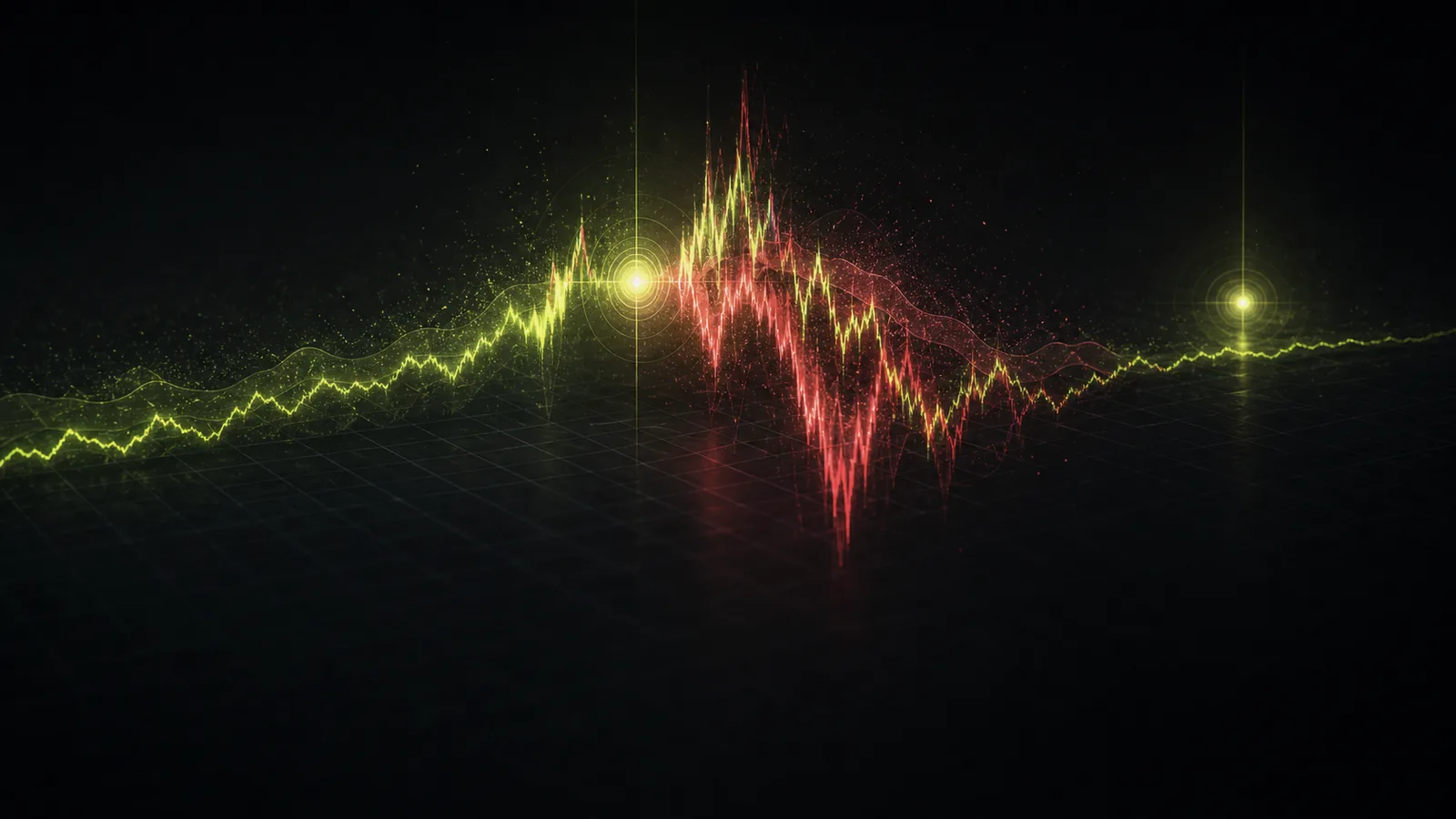
A violent whipsaw sits beside a calm marker outside the hazard
Delta-X Academy

Trading the Release or Standing Aside

Original Delta-X illustration.
reader9 min read

Trading the release means engaging with the price action in the moments around a high-impact data event, when volatility, spreads, and slippage spike. For many traders the better choice is standing aside, flattening or avoiding fresh positions through the first minutes, because the initial reaction is chaotic and often whipsaws before any durable move appears.

Target audience: Traders who get whipsawed and slipped trying to trade the first candle after big news.

Learning objectives

  • Describe why the first minutes after a release are hostile.
  • Recognise the spike, the fade, and the durable move.
  • Treat standing aside as a deliberate position.
  • Engage a release only with rules suited to the conditions.

Definition

Trading the release means engaging with the price action in the moments around a high-impact data event, when volatility, spreads, and slippage spike. For many traders the better choice is standing aside, flattening or avoiding fresh positions through the first minutes, because the initial reaction is chaotic and often whipsaws before any durable move appears.

Why it matters

The seconds after a major release are among the most hostile conditions a trader faces: spreads widen, liquidity thins, obvious stops are run, and the first move frequently reverses. Knowing this lets you make a deliberate choice, to stand aside, or to engage only with rules suited to the chaos, rather than being caught mid-setup by a violent, spread-widened spike that has nothing to do with your edge.

Why the first minutes are hostile

On a high-impact release, liquidity providers pull back, spreads widen sharply, and the first orders create a violent move that can overshoot wildly. Stops resting at obvious levels are easily run in the spike, and fills come with heavy slippage. These conditions are the opposite of the orderly market most setups assume, so a position held into the release is exposed to costs and moves that have nothing to do with its original logic. The hostility is structural, a feature of thin, fast conditions, not bad luck.

The spike, the fade, the real move

A common pattern is an initial knee-jerk spike that overshoots, a fade or reversal as the details are digested and the overshoot unwinds, and only then a more durable move in whatever direction the release genuinely justified. The first print of price is frequently a liquidity event, a spike that pushes just past obvious levels and runs the stops resting there, more than a considered repricing. This is why chasing the first candle is so often punished, and why waiting for the initial volatility to resolve, and watching whether the move holds or fades, tends to give a far clearer read.

Standing aside is a position

Choosing not to trade the release is itself a deliberate, often profitable decision, not a failure to act. Flattening before a high-impact event, or simply not opening into it, removes you from the worst of the chaos and lets you re-engage once spreads normalise and a direction holds. Traders who do engage the release usually do so with specific rules, wider stops, smaller size, waiting for a candle to close beyond a level, precisely because the default conditions are so hostile. The simplest edge around releases is often patience: let the spike and fade happen to other people, and trade the clearer move that follows.

Visual models

ICT structure map: BOS into imbalance, liquidity sweep, then CHoCH through the FVG
Market structure mapAn uptrend breaks structure, leaves a fair value gap, sweeps the prior high for liquidity, then changes character lower through the imbalance.BOS above swing1liquidity sweep2FVG3CHoCH lower4158236300prior swing highbreak below structureBOSFVGCHoCHpricemarket structure sequence

Worked examples

Example 1: Run by the spike

A trader holds a position with a tight stop through a major release. The first print spikes hard against them, sweeping their stop on a widened spread, then reverses back in their original direction within two minutes, leaving them stopped out at the worst price just before the move they expected. The release ultimately justified their view, but the hostile first minutes took them out first. A trader who had flattened before the print, or used a wider stop and smaller size designed for the conditions, would have survived the spike and kept the durable move that followed.

Common mistakes

Holding tight stops through a high-impact release.

Chasing the first spike before it holds.

Treating standing aside as a failure rather than a choice.

Using normal-condition size and stops into abnormal conditions.

Assuming the first move after the print is the durable direction.

Myth vs reality

Myth

That the first move after a release is the durable direction.

Reality

No paired reality note provided.

Myth

That you must trade every event.

Reality

No paired reality note provided.

Myth

That spreads and slippage around news are negligible.

Reality

No paired reality note provided.

Risk considerations

  • Spreads widen and obvious stops are run on the spike.
  • The initial move frequently reverses and fills come with heavy slippage.

Practice exercises

1. Stand aside and watch

For one high-impact release, decide in advance to stand aside and observe the pattern.

  1. Choose a scheduled high-impact release and decide in advance not to trade it.
  2. Watch the first print: note the spike and how far it overshot.
  3. Watch whether it faded or reversed before a durable move set in.
  4. Note what a tight stop in the first minute would have suffered.

Quiz

Q1. Why are the first minutes after a high-impact release so hostile?

Q2. What is the common spike-fade-resume pattern?

Q3. Why is standing aside a position rather than a failure?

Next lesson

Positioning, Sentiment and Crowded Trades

Continue to next

This lesson is educational content only and is not financial advice. Macroeconomic analysis is interpretive and frequently wrong; the relationships it describes are tendencies that vary by regime and break down, not laws, and a correct macro view does not produce a profitable trade. Nothing here is a forecast or a recommendation to buy or sell. Markets carry substantial risk. Trade only with risk you can afford to lose, and let price and your own risk rules, not a macro narrative, govern any position.

Trading the Release or Standing Aside · Academy · Delta-X