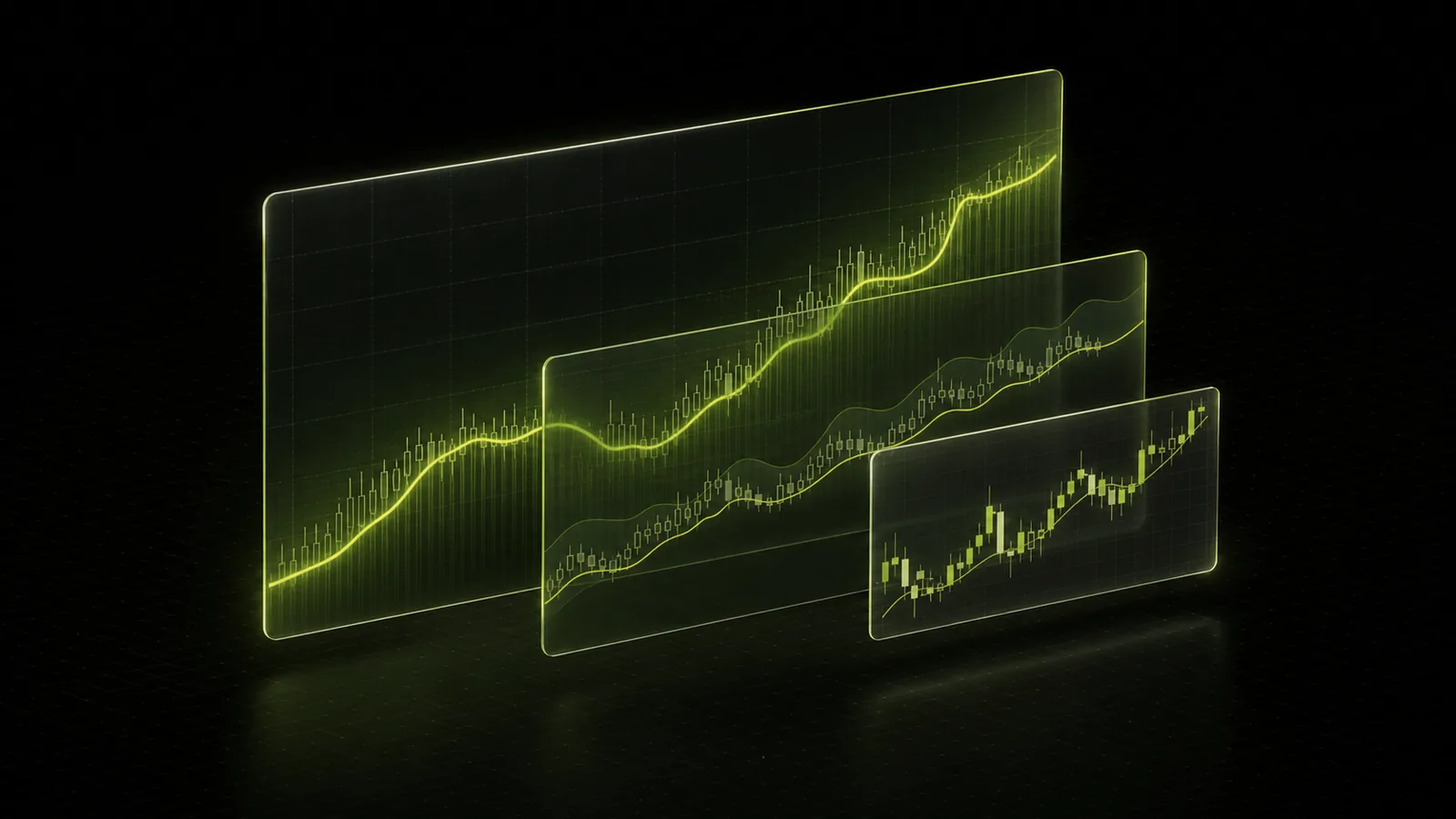
Three chart planes align to show higher time frame context and lower time frame timing
Delta-X Academy

Timeframes and Multi-Timeframe Analysis

Original Delta-X illustration.
free9 min read

A timeframe is the period each candle represents, from one minute to one month. Multi-timeframe analysis is the practice of reading a higher timeframe for context and direction, then dropping to a lower one to time an entry, so the two agree before you act.

Target audience: Traders who keep getting stopped out by moves that a higher timeframe would have warned them about.

Learning objectives

  • Explain what the timeframe of a chart changes about its meaning.
  • Use a higher timeframe for context and a lower one for timing.
  • Avoid analysis paralysis from watching too many timeframes at once.
  • Recognise when timeframes disagree and what that conflict implies.

Definition

A timeframe is the period each candle represents, from one minute to one month. Multi-timeframe analysis is the practice of reading a higher timeframe for context and direction, then dropping to a lower one to time an entry, so the two agree before you act.

Why it matters

The same chart looks bullish on one timeframe and bearish on another, and traders who watch only one are constantly surprised by moves that were obvious one level up. Aligning a higher timeframe with a lower one is one of the simplest ways to stop fighting the dominant trend and to avoid entries that look clean up close but sit against the larger picture.

The same market, many lenses

A one-minute chart and a daily chart of the same market can tell opposite stories at the same moment. A sharp one-minute decline can be a tiny pullback inside a strong daily uptrend. Neither chart is wrong; they describe different horizons. The higher the timeframe, the more weight its levels and trends carry, because more participants and more time went into forming them. Choosing your timeframes is really choosing which horizon you are trading and which noise you are willing to ignore.

Context first, timing second

A practical structure uses two or three timeframes. The highest sets direction and the major levels: is the larger trend up, down, or ranging, and where are the obvious support and resistance areas. The middle timeframe, if you use one, refines the setup. The lowest is only for timing the entry once the higher ones agree. The rule is simple: never let the lowest timeframe talk you into a trade that fights the highest. Context comes from above and timing comes from below.

Too many screens is its own trap

More timeframes do not mean more clarity. Watching five at once usually produces conflicting signals and indecision, because at any moment some timeframe is doing the opposite of another. Two or three with a clear job each is enough. A common pairing is a factor of roughly four to six between them, for example daily for context, hourly for the setup, and five or fifteen minutes for the entry. Pick a stack, give each timeframe one role, and resist the urge to keep adding screens.

Visual models

Multi-timeframe analysis: the higher timeframe sets the bias, the lower timeframe times the entry
Multi-timeframe alignmentThe upper higher-timeframe panel shows an uptrend pulling back into a demand zone. The lower zoomed panel shows the lower timeframe making a higher low inside that zone, which is the entry aligned with the higher-timeframe bias.higher timeframe: biasuptrend intactpullback to demand1zoom inlower timeframe: entryhigher lowentry: aligned with bias2trade the lower timeframe in the direction of the higher timeframe
Multi-timeframe analysis: the higher timeframe sets the bias, the lower timeframe times the entry
Multi-timeframe alignmentThe upper higher-timeframe panel shows an uptrend pulling back into a demand zone. The lower zoomed panel shows the lower timeframe making a higher low inside that zone, which is the entry aligned with the higher-timeframe bias.higher timeframe: biasuptrend intactpullback to demand1zoom inlower timeframe: entryhigher lowentry: aligned with bias2trade the lower timeframe in the direction of the higher timeframe

Worked examples

Example 1: A pullback that only made sense from above

On the five-minute chart a trader sees price falling hard and shorts it, expecting more downside. On the daily chart, price is sitting exactly on a support area that has held three times, and the larger trend is up. The five-minute decline is just a pullback into daily support. The short fights the dominant trend and gets squeezed as buyers step in at the level. Reading the daily first would have flipped the bias from short to looking for longs at support.

Common mistakes

Trading the lowest timeframe while ignoring the higher-timeframe trend.

Watching so many timeframes that every signal is contradicted by another.

Treating a tiny lower-timeframe move as if it changed the larger trend.

Using timeframes that are too close together to add real context.

Switching timeframes after entry to justify holding a losing trade.

Myth vs reality

Myth

That a lower timeframe gives earlier and therefore better signals.

Reality

No paired reality note provided.

Myth

That all timeframes should always agree before you can ever trade.

Reality

No paired reality note provided.

Myth

That the timeframe you watch most is the one that matters most.

Reality

No paired reality note provided.

Risk considerations

  • Lower timeframes generate more signals, most of which are noise.
  • A clean lower-timeframe entry against a higher-timeframe trend has a poor edge.

Practice exercises

1. Build a three-timeframe view

Choose one market and define a higher, middle, and lower timeframe, each with a single job.

  1. Pick a higher timeframe and write down the trend and the major levels.
  2. Pick a middle timeframe and describe the current setup within that context.
  3. Pick a lower timeframe and state what entry trigger you would wait for.
  4. Note one trade idea where all three agree and one where they conflict.

Quiz

Q1. What is the role of the higher timeframe in multi-timeframe analysis?

Q2. Why is watching too many timeframes a problem?

Q3. What is the rule when the lowest timeframe disagrees with the highest?

Next lesson

Trend and Market Structure

Continue to next

This lesson is educational content only and is not financial advice. Charts and indicators describe what price has already done; they do not predict the future or guarantee any outcome. No indicator works in every market or timeframe. Trading involves substantial risk, and you should trade only with risk you can afford to lose.