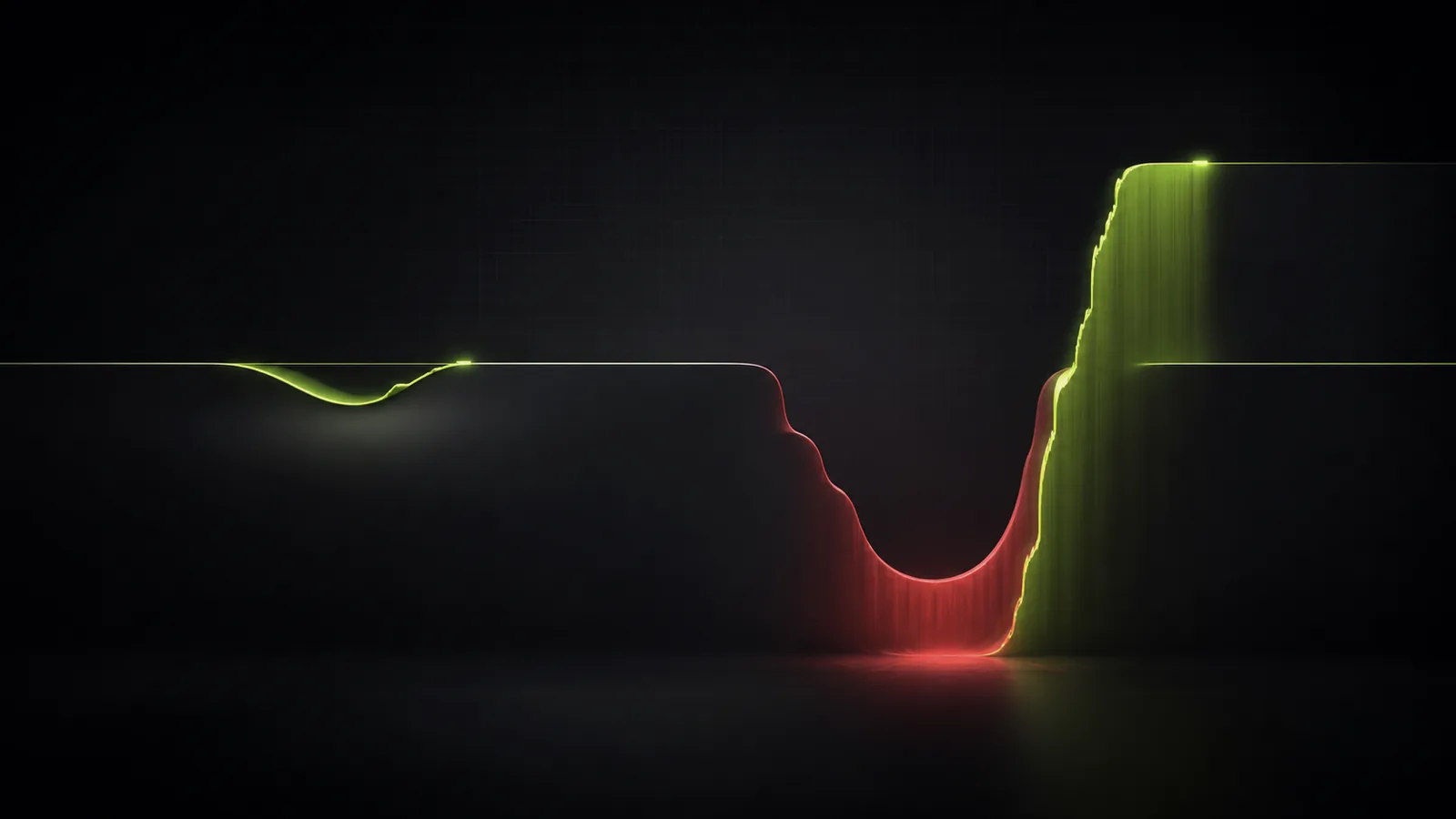
A shallow dip returns quickly while a deep red drawdown needs a towering climb back
Delta-X Academy

The Drawdown Recovery Asymmetry

Original Delta-X illustration.
free9 min read

A drawdown of a fraction d requires a gain of d divided by one minus d to get back to even, because the recovery is computed on the reduced capital that remains. This makes recovery accelerate brutally as drawdowns deepen: a small loss needs a similar gain, but a large loss needs a far larger one.

Target audience: Traders who assume recovering a drawdown takes a gain of the same size as the loss.

Learning objectives

  • Compute the gain needed to recover a given drawdown.
  • Explain why recovery is computed on the reduced capital.
  • Describe how recovery cost accelerates with depth.
  • Use the asymmetry as a reason to cap losses early.

Definition

A drawdown of a fraction d requires a gain of d divided by one minus d to get back to even, because the recovery is computed on the reduced capital that remains. This makes recovery accelerate brutally as drawdowns deepen: a small loss needs a similar gain, but a large loss needs a far larger one.

Why it matters

Traders underestimate deep drawdowns because they think a 50 percent loss needs a 50 percent gain to recover. It needs 100 percent. The recovery math is non-linear, and understanding it is what turns drawdown from an abstract discomfort into a concrete reason to cap losses before they compound into a hole that is mathematically hard to climb out of.

Recovery is on what is left

When you lose a fraction d of your capital, the gain you need to get back to even is not d; it is d divided by one minus d. The reason is that the recovery is earned on the smaller capital that survives the loss, not on the original. Lose ten percent and you have ninety left, so you need to make about eleven percent on that ninety to get back. Lose twenty percent and you need twenty-five percent. The recovery gain is always larger than the loss, and the gap widens as the loss grows.

The asymmetry gets brutal

Because of that formula, the cost of recovery accelerates. A loss of a third requires a gain of fifty percent to recover. A loss of half requires a gain of one hundred percent, a doubling, just to get back to where you started. A loss of seventy-five percent requires a three hundred percent gain, and a loss of ninety percent requires nine hundred percent. The curve is gentle for shallow drawdowns and then turns vertical, which is why deep drawdowns are not just bigger versions of small ones; they are a different kind of problem.

Cap the loss before it compounds

The practical lesson of the recovery asymmetry is to keep drawdowns shallow, because once they are deep the required gain is in a range that is statistically hard to achieve without taking the very risks that caused the hole. A trader who limits the maximum drawdown stays in the gentle part of the curve, where recovery is realistic. A trader who lets a drawdown run into the steep part needs a heroic, often desperate, run just to break even, and the pressure to chase it is exactly what deepens it further.

Visual models

Drawdown recovery curve: the gain required accelerates as equity base shrinks
Drawdown recovery curveA convex recovery curve shows that small losses require modest gains, while deep drawdowns require dramatically larger gains on a reduced equity base.0%+25%+50%+75%+100%+125%+150%-0%-10%-20%-30%-40%-50%-60%-10% -> +11%-20% -> +25%-50% -> +100%Recovery is earned on less capitalA 50% loss doubles the required return.The first job is keeping the curve shallow.gain to recoverdrawdown from equity peak

Worked examples

Example 1: Fifty down needs a double

Start with one hundred thousand and lose half, leaving fifty thousand. To get back to one hundred thousand you must turn fifty into one hundred, which is a one hundred percent gain, a full double, on the reduced capital. Compare a ten percent drawdown: from ninety thousand back to one hundred is about eleven percent. The loss doubled five times over from ten to fifty percent, but the recovery gain ballooned from eleven percent to one hundred percent, far more than five times. That non-linear blow-up is the recovery asymmetry in numbers.

Drawdown recovery curve: the gain required accelerates as equity base shrinks
Drawdown recovery curveA convex recovery curve shows that small losses require modest gains, while deep drawdowns require dramatically larger gains on a reduced equity base.0%+25%+50%+75%+100%+125%+150%-0%-10%-20%-30%-40%-50%-60%-10% -> +11%-20% -> +25%-50% -> +100%Recovery is earned on less capitalA 50% loss doubles the required return.The first job is keeping the curve shallow.gain to recoverdrawdown from equity peak

Common mistakes

Assuming a loss needs an equal-sized gain to recover.

Letting a drawdown run into the steep part of the curve.

Chasing a deep drawdown back with larger, riskier bets.

Treating a deep drawdown as just a bigger shallow one.

Ignoring that recovery is earned on the reduced capital.

Myth vs reality

Myth

That a fifty percent loss needs a fifty percent gain to recover.

Reality

No paired reality note provided.

Myth

That recovery cost grows in proportion to the loss.

Reality

No paired reality note provided.

Myth

That deep drawdowns are recoverable on the same terms as shallow ones.

Reality

No paired reality note provided.

Risk considerations

  • Deep drawdowns require gains that are statistically hard to achieve safely.
  • The pressure to recover a deep hole drives the risk-taking that deepens it.

Practice exercises

1. Build your recovery table

Compute the recovery gain for a range of drawdowns to feel the asymmetry.

  1. For drawdowns of ten, twenty, a third, fifty, and seventy-five percent, compute d divided by one minus d.
  2. Note where the required gain starts to outrun the loss sharply.
  3. Decide the maximum drawdown that keeps you in the recoverable range.
  4. Set a hard limit that stops losses before they reach the steep part.

Quiz

Q1. What gain recovers a drawdown of fraction d?

Q2. What gain does a fifty percent loss require to recover?

Q3. Why does the recovery asymmetry argue for capping losses early?

Try it yourself

Put the lesson math into an interactive lab and check the numbers.

Max DD in $
$10,000
Daily DD in $
$5,000
1% losses to bust
10
Total loss room
10%

Read: you can lose 10trades of 1% before your account is busted under this firm's static drawdown. Trailing drawdown firms tighten this number after every winning streak.

Next lesson

Losing Streaks Are Normal

Continue to next

This lesson is educational content only and is not financial advice. The formulas here are models that rely on stated assumptions (such as a known, fixed edge and independent trades); real markets violate those assumptions, so treat the numbers as intuition, not guarantees. Trading involves substantial risk of loss, and no sizing method removes it. Trade only with risk you can afford to lose.