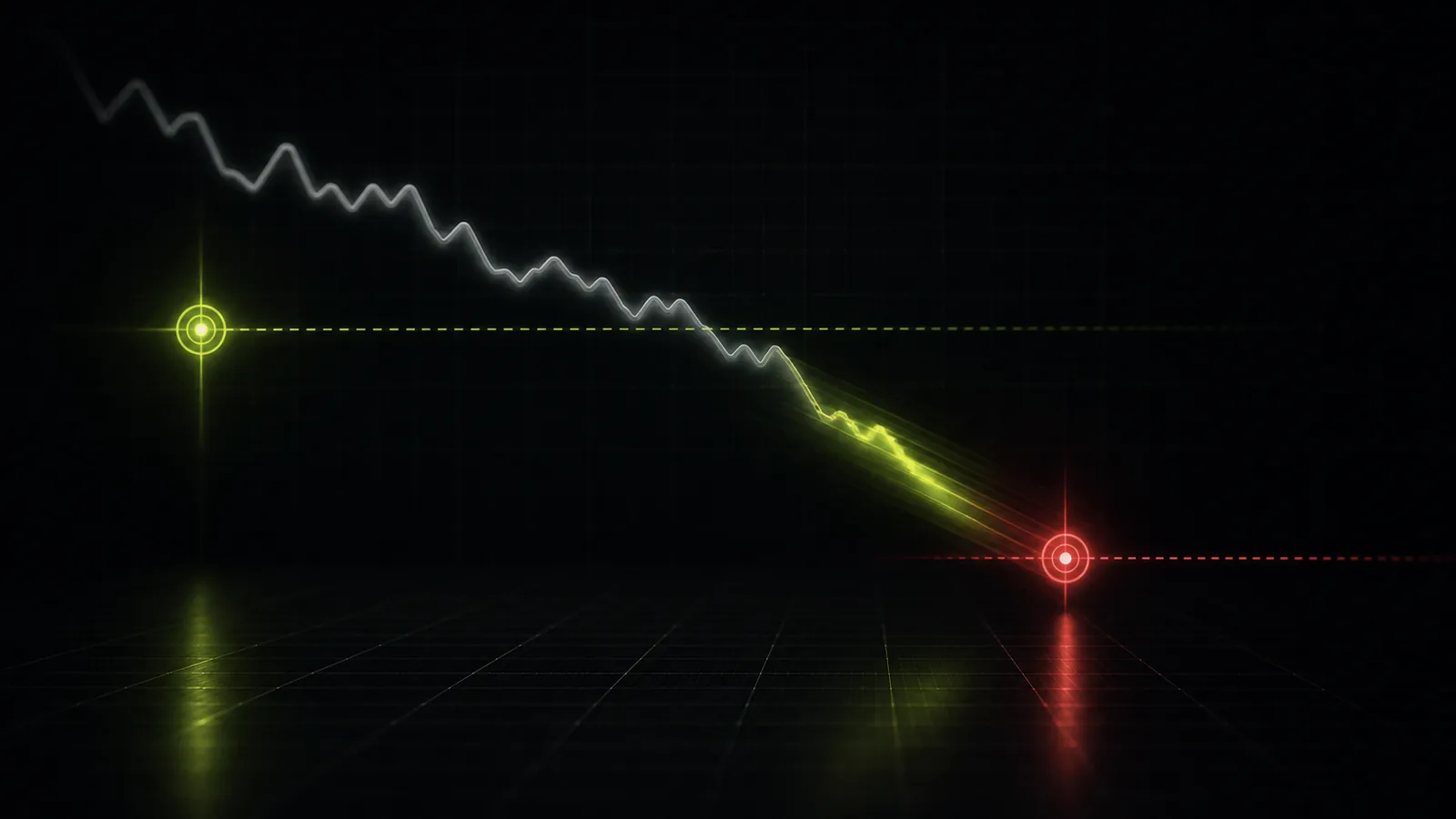
An intended fill marker and a later actual fill marker sit apart
Delta-X Academy

Slippage: Why Fills Differ From Your Price

Original Delta-X illustration.
free8 min read

Slippage is the difference between the price you expected and the price you actually filled at. It happens when the market moves between your decision and your execution, or when your order is too large or the book too thin to fill at one price. It can be negative (worse) or, less often, positive (better).

Target audience: Traders whose live results trail their backtests and who blame the strategy rather than the fills.

Learning objectives

  • Define slippage and its two directions.
  • Identify the conditions that produce slippage.
  • Explain why stops are especially exposed to it.
  • Build a slippage allowance into expectations.

Definition

Slippage is the difference between the price you expected and the price you actually filled at. It happens when the market moves between your decision and your execution, or when your order is too large or the book too thin to fill at one price. It can be negative (worse) or, less often, positive (better).

Why it matters

Slippage is the gap between a backtest and reality. A strategy that looks profitable on clean closing prices can be a loser once real fills are accounted for, especially on stops in fast markets. Understanding when slippage strikes, fast moves, thin books, gaps, and large size, lets you build it into expectations and stop being surprised when your stop fills well past where you set it.

The gap between intent and fill

When you decide to trade at a price and the market fills you somewhere else, the difference is slippage. A market order sent into a moving market fills at whatever the book offers by the time it arrives, which may be a few ticks away from the last price you saw. Most slippage is negative, meaning worse than expected, because you are most likely to be crossing the spread aggressively exactly when the market is moving against the side you are taking. Occasionally it is positive, filling better than intended.

When slippage strikes

Slippage grows in three conditions. The first is speed: in a fast move, price travels between your click and your fill. The second is thinness: if the book has little resting liquidity, even a modest order walks through several price levels to fill. The third is the gap: when a market reopens far from where it closed, any order, including a stop, fills at the new level, not the old one. Quiet, deep, liquid markets have little slippage; fast, thin, gapping ones have a lot.

Why stops suffer most

Protective stops are exposed to slippage by their nature, because they trigger precisely when the market is moving fast against you, which is the worst moment to be crossing the spread. A stop set at a level can fill several ticks beyond it in a sharp move, and through a gap it can fill far past it. This does not mean stops are useless; it means the realistic risk on a trade is a little wider than the stop distance suggests, and a strategy that ignores this underestimates its losses.

Worked examples

Example 1: The backtest that ignored slippage

A breakout strategy backtests beautifully assuming entries and stops fill exactly at their levels. Traded live, entries fill a tick or two into the breakout and stops fill two or three ticks past their trigger in the fast reversals the strategy is prone to. Each trade loses a few extra ticks to slippage on both ends. On a strategy whose average win was only a handful of ticks larger than its average loss, that friction flips the whole edge negative. The strategy did not fail; the backtest lied by assuming perfect fills.

Common mistakes

Backtesting on clean prices and assuming fills will match.

Setting a stop and treating its level as the exact worst case.

Sending large orders into thin books and blaming the platform for the fill.

Trading illiquid instruments at speed and expecting tight fills.

Ignoring gap risk on positions held through a close.

Myth vs reality

Myth

That your fill will match the price on the screen.

Reality

No paired reality note provided.

Myth

That a stop caps your loss exactly at its level.

Reality

No paired reality note provided.

Myth

That slippage is rare enough to ignore in expectations.

Reality

No paired reality note provided.

Risk considerations

  • Real risk per trade is a little wider than the stop distance implies.
  • Gaps can fill a stop far beyond its trigger, well past the planned loss.

Practice exercises

1. Log your real slippage

Measure the slippage you actually experience instead of assuming there is none.

  1. For your next ten trades, record the price you intended and the price you filled.
  2. Note the conditions: fast or slow, liquid or thin, any gap.
  3. Average the slippage per trade in ticks for entries and for stops.
  4. Add that average back into your strategy's expected results.

Quiz

Q1. What is slippage?

Q2. What three conditions increase slippage?

Q3. Why are protective stops especially exposed to slippage?

Next lesson

Liquidity and Market Depth

Continue to next

This lesson is educational content only and is not financial advice. Order types, fees, and execution behaviour vary by broker, venue, and market; always read your own platform's documentation. Trading involves substantial risk, and good execution cannot turn a losing strategy into a winning one. Trade only with risk you can afford to lose.