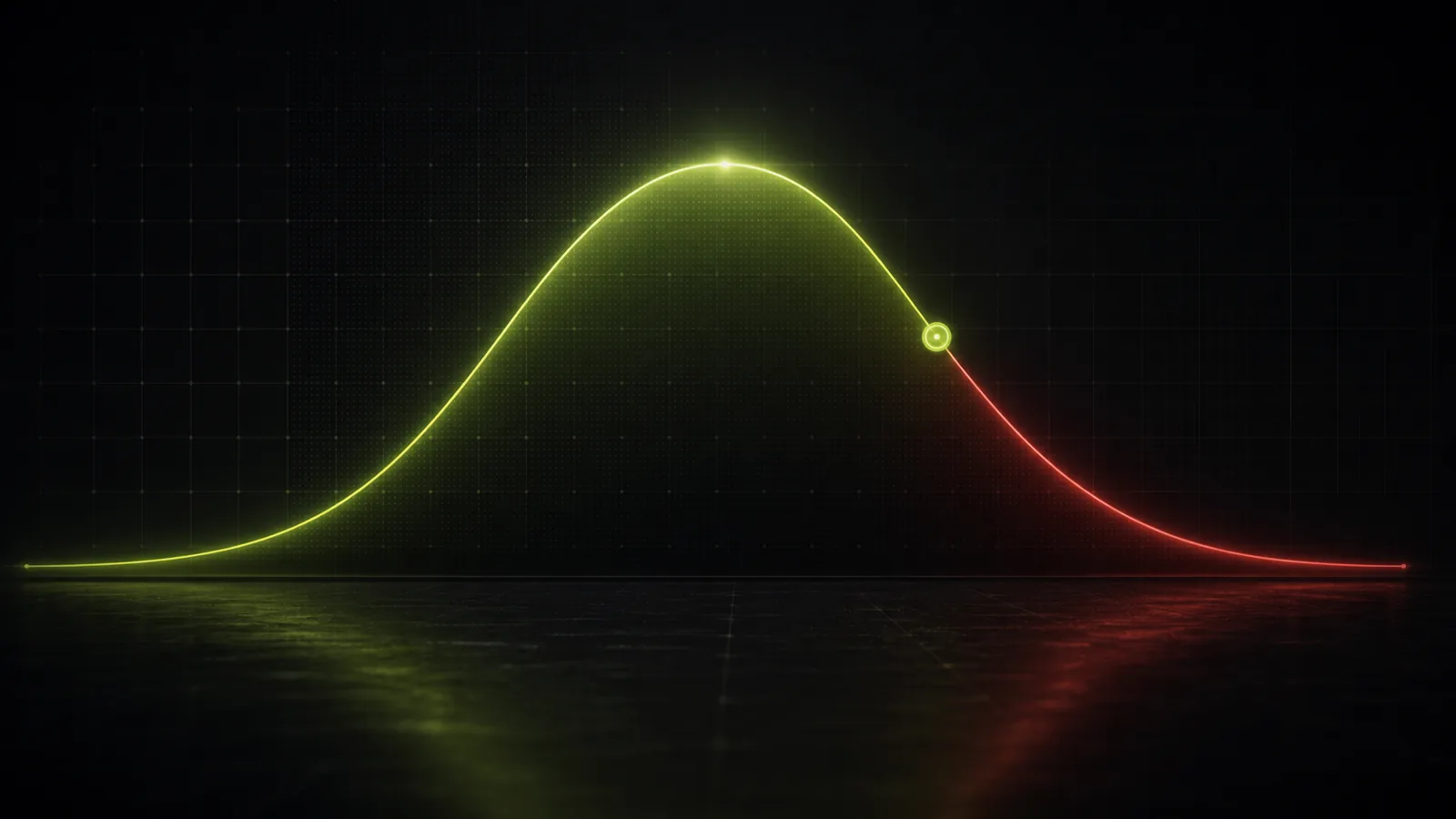
A smooth focus curve rises then falls into overstrain
Delta-X Academy

Self-Awareness and Managing Your State

Original Delta-X illustration.
free9 min read

State management is noticing your own emotional and physical condition and adjusting your trading to it: trading normally when calm and focused, trading smaller or not at all when tired, stressed, angry, or distracted. It treats your state as a real input to risk, because the same plan executed in a poor state produces worse decisions.

Target audience: Traders who trade the same regardless of how tired, stressed, or distracted they are.

Learning objectives

  • Define state management and why state is a risk input.
  • Describe the relationship between arousal and performance.
  • Notice your own state honestly and early.
  • Adjust or stop trading based on your state.

Definition

State management is noticing your own emotional and physical condition and adjusting your trading to it: trading normally when calm and focused, trading smaller or not at all when tired, stressed, angry, or distracted. It treats your state as a real input to risk, because the same plan executed in a poor state produces worse decisions.

Why it matters

Every emotional skill in this path depends on first noticing what state you are in, because you cannot manage a feeling you have not registered. A trader who can tell, honestly and early, that they are not in a fit state to trade, and who acts on it, avoids most of the damage the other lessons describe, because they step away before the poor state turns into a poor decision.

Your state is a risk input

You do not trade your plan in a vacuum; you trade it through whatever state you are in, and the same plan run by a tired, stressed, or angry version of you produces worse decisions than the calm version would. This makes your internal state a genuine input to risk, as real as volatility or position size, and usually a more neglected one. State management is simply treating it that way: checking your condition before and during a session and adjusting your exposure to match, rather than assuming you will execute identically no matter how you feel.

Arousal and performance

Performance does not rise endlessly with intensity. A common way to picture this is an inverted-U, sometimes called the Yerkes-Dodson relationship: too little arousal and you are flat and careless, a moderate amount and you are sharp and focused, too much and stress tends to narrow your attention and degrade judgement. The precise evidence behind the inverted-U is more nuanced than the popular version suggests, but as a rough guide it captures something many traders recognise: most self-inflicted damage happens on the over-aroused far side, when high stress, anger, or fear push you past your best into reactive decisions. The practical takeaway is simply that more intensity is not better past a point, and that recognising over-arousal is a cue to step back, not push harder.

Notice early, adjust honestly

The skill has two parts: noticing and acting. Noticing means checking in honestly, am I rested, calm, and focused, or tired, wound up, distracted, before and during the session, ideally with a simple habit rather than relying on a vague sense. Acting means matching your trading to the answer: trade normally in a good state, trade smaller in a marginal one, and do not trade at all in a poor one. The hardest part is honesty, because a poor state often comes with the conviction that you are fine. Building the check into your routine, and pre-committing to reduce or stop when the answer is bad, is what turns self-awareness into protection.

Visual models

Plan under pressure: execution quality collapses before equity damage accelerates
Discipline under pressure chartA two-panel chart shows equity above rule adherence. The tilt zone coincides with a sharp adherence collapse and a larger equity drawdown, followed by a reset.$101,600$100,000$96,05025%50%75%100%123456789101112tilt: plan abandonedreset: size downsmall losses became largeequityrules followedtrade sequence

Worked examples

Example 1: Trading tired

A trader sits down exhausted and wired after a bad night and a stressful morning, but trades their normal size as if nothing were different. In that state they miss obvious signals, react instead of think, and make a series of sloppy decisions that a rested version of them would not have. The setups were the same; the operator was degraded. A trader who checked in, recognised the poor state, and either traded a fraction of normal size or took the day off, would have skipped the entire avoidable loss. The state, not the market, was the risk that day.

Common mistakes

Trading the same size regardless of your state.

Assuming more intensity always improves performance.

Relying on a vague sense instead of an honest, regular check.

Believing you are fine when a poor state says otherwise.

Not pre-committing to reduce or stop when your state is bad.

Myth vs reality

Myth

That you execute your plan identically regardless of your state.

Reality

No paired reality note provided.

Myth

That higher arousal keeps improving performance.

Reality

No paired reality note provided.

Myth

That you can always tell in the moment when your state is poor.

Reality

No paired reality note provided.

Risk considerations

  • A poor state degrades the same plan into worse decisions.
  • Over-arousal often comes with false confidence that you are fine.

Practice exercises

1. Build a state check

Add a simple state check to your routine and pre-commit to acting on it.

  1. Write a short check: rested, calm, focused, or tired, stressed, distracted.
  2. Run it before the session and again if something rattles you.
  3. Decide the rule: normal size when good, smaller when marginal, none when poor.
  4. Pre-commit to the rule now, while calm, so a poor state cannot override it.

Quiz

Q1. Why is your state a genuine risk input?

Q2. What is the arousal-performance relationship?

Q3. What are the two parts of state management?

Path complete

You have reached the end of this path

Nice work finishing the path. Revisit any lesson to reinforce it, or explore another path in the academy.

Back to the academy

This lesson is educational content only and is not financial, psychological, or medical advice. It describes patterns common among traders, which vary from person to person; if difficult emotions around trading or money are affecting your wellbeing, seek qualified support. Managing your psychology improves your decisions but does not remove the substantial risk of trading. Trade only with risk you can afford to lose.