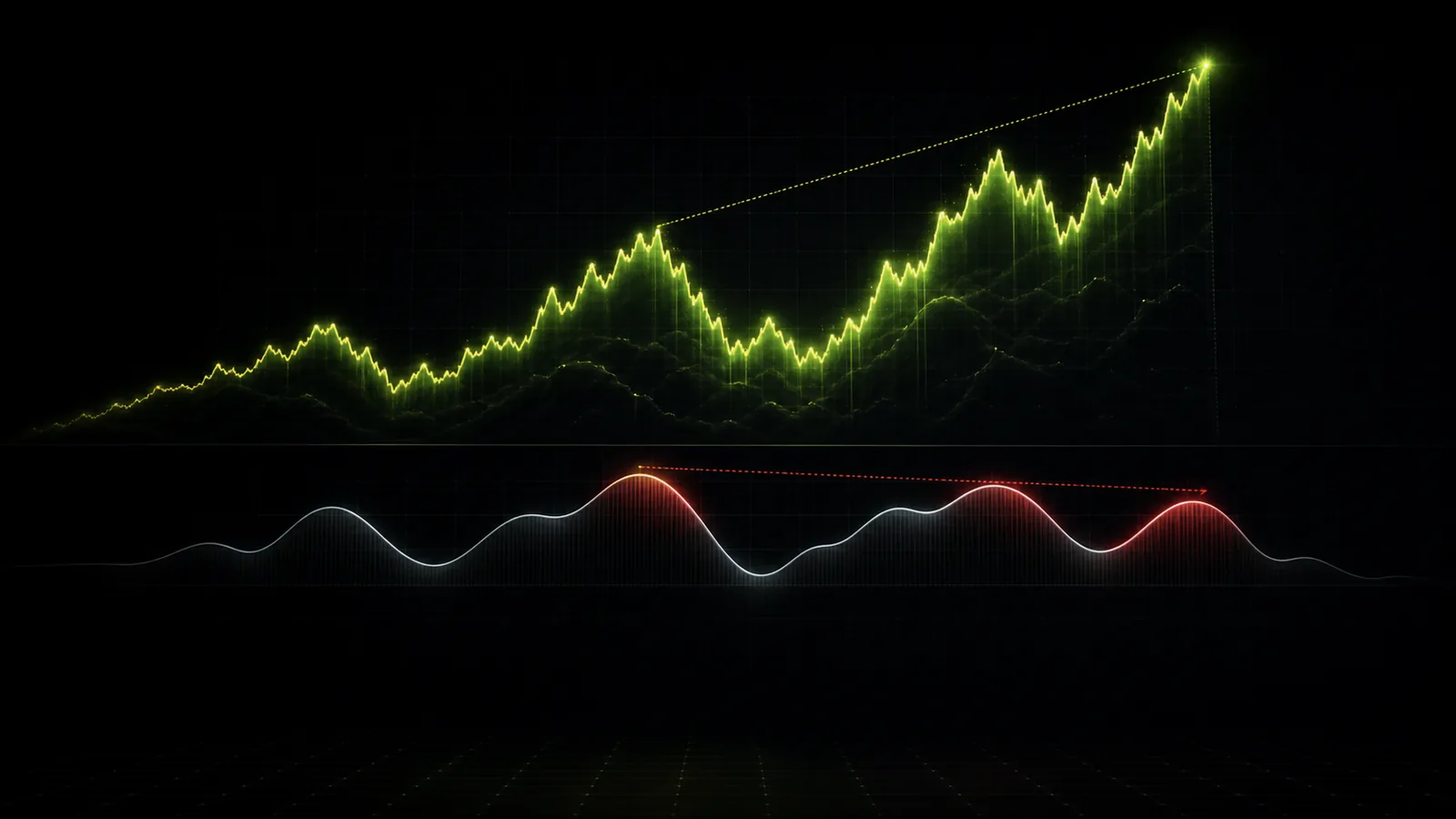
Price and momentum diverge across stacked chart panels
Delta-X Academy

Momentum Oscillators: RSI and MACD

Original Delta-X illustration.
free9 min read

A momentum oscillator measures the speed and strength of price movement rather than its level. RSI scales recent gains against recent losses on a zero-to-one-hundred range, while MACD tracks the gap between two moving averages. Both describe momentum, and neither predicts reversals on its own.

Target audience: Traders tempted to buy oversold and sell overbought who need to understand why that fails.

Learning objectives

  • Explain what RSI and MACD each measure.
  • Describe why overbought does not mean sell in a trend.
  • Define momentum divergence and its limits.
  • Use oscillators as context rather than as standalone signals.

Definition

A momentum oscillator measures the speed and strength of price movement rather than its level. RSI scales recent gains against recent losses on a zero-to-one-hundred range, while MACD tracks the gap between two moving averages. Both describe momentum, and neither predicts reversals on its own.

Why it matters

Oscillators are heavily marketed as overbought and oversold signals, and traders who take them literally short every overbought reading in a strong uptrend and lose repeatedly. Understanding what these tools actually measure, and their core failure mode, turns them from a source of bad signals into a modest source of context about whether momentum is building or fading.

What RSI and MACD measure

RSI, the relative strength index, compares the size of recent up moves to recent down moves and expresses it from zero to one hundred. High readings mean recent gains have dominated; low readings mean losses have. MACD plots the difference between a faster and a slower moving average, with a signal line on top, so it rises as the averages spread apart and falls as they converge. Both are derived entirely from price, so they are summaries of momentum, not independent information about the future.

Overbought is not a sell

The most expensive misreading is treating a high RSI as a sell and a low RSI as a buy. In a strong uptrend, RSI can stay overbought for a long time while price keeps climbing, and selling each overbought reading is fighting the trend into a wall. Overbought really means momentum is strong, which in a trend is a sign of health, not a top. These thresholds are only useful for fading in clearly range-bound markets, and even there they are a context cue, not a trigger.

Divergence and its limits

Divergence is when price makes a new extreme but the oscillator does not, for example a higher high in price with a lower high in RSI, suggesting momentum is fading even as price pushes on. It can be an early hint that a move is tiring, but it is unreliable as a signal on its own: momentum can diverge for a long time before price turns, or never turn at all. Divergence is best used to raise caution and tighten management on an existing position, not to enter a counter-trend trade by itself.

Worked examples

Example 1: Shorting overbought in a trend

A stock breaks out and trends up for weeks. A trader watches RSI hit overbought and shorts, expecting a reversal. RSI stays overbought and price keeps rising, so the short is stopped out. The trader shorts the next overbought reading and is stopped again. RSI was not lying; it was reporting strong, healthy momentum in a trend. The same overbought reading inside a clear range, where price was already stalling at resistance, would have been a far more reasonable context cue to consider a fade.

Common mistakes

Shorting overbought and buying oversold readings inside a strong trend.

Entering a counter-trend trade on divergence alone.

Treating oscillator thresholds as triggers rather than context.

Adding several oscillators that all measure roughly the same thing.

Ignoring the trend and reading the oscillator in isolation.

Myth vs reality

Myth

That overbought means a top and oversold means a bottom.

Reality

No paired reality note provided.

Myth

That divergence reliably marks the turn in price.

Reality

No paired reality note provided.

Myth

That an oscillator adds information beyond what price already shows.

Reality

No paired reality note provided.

Risk considerations

  • Oscillator extremes can persist far longer than a counter-trend position survives.
  • Divergence can run for a long time before price turns, if it turns at all.

Practice exercises

1. Test overbought in trend and range

Compare how an oscillator behaves in a trending market and a ranging one on the same instrument.

  1. Add RSI to a clearly trending chart and mark every overbought reading.
  2. Check what price did after each overbought reading in the trend.
  3. Repeat on a ranging stretch and compare the outcomes at the extremes.
  4. Write one sentence on when the oscillator was useful and when it was a trap.

Quiz

Q1. What does a momentum oscillator measure?

Q2. Why is a high RSI not a sell signal in a trend?

Q3. How should divergence be used?

Path complete

You have reached the end of this path

Nice work finishing the path. Revisit any lesson to reinforce it, or explore another path in the academy.

Back to the academy

This lesson is educational content only and is not financial advice. Charts and indicators describe what price has already done; they do not predict the future or guarantee any outcome. No indicator works in every market or timeframe. Trading involves substantial risk, and you should trade only with risk you can afford to lose.