free11 min read

Auction Failure and Value-Area Migration

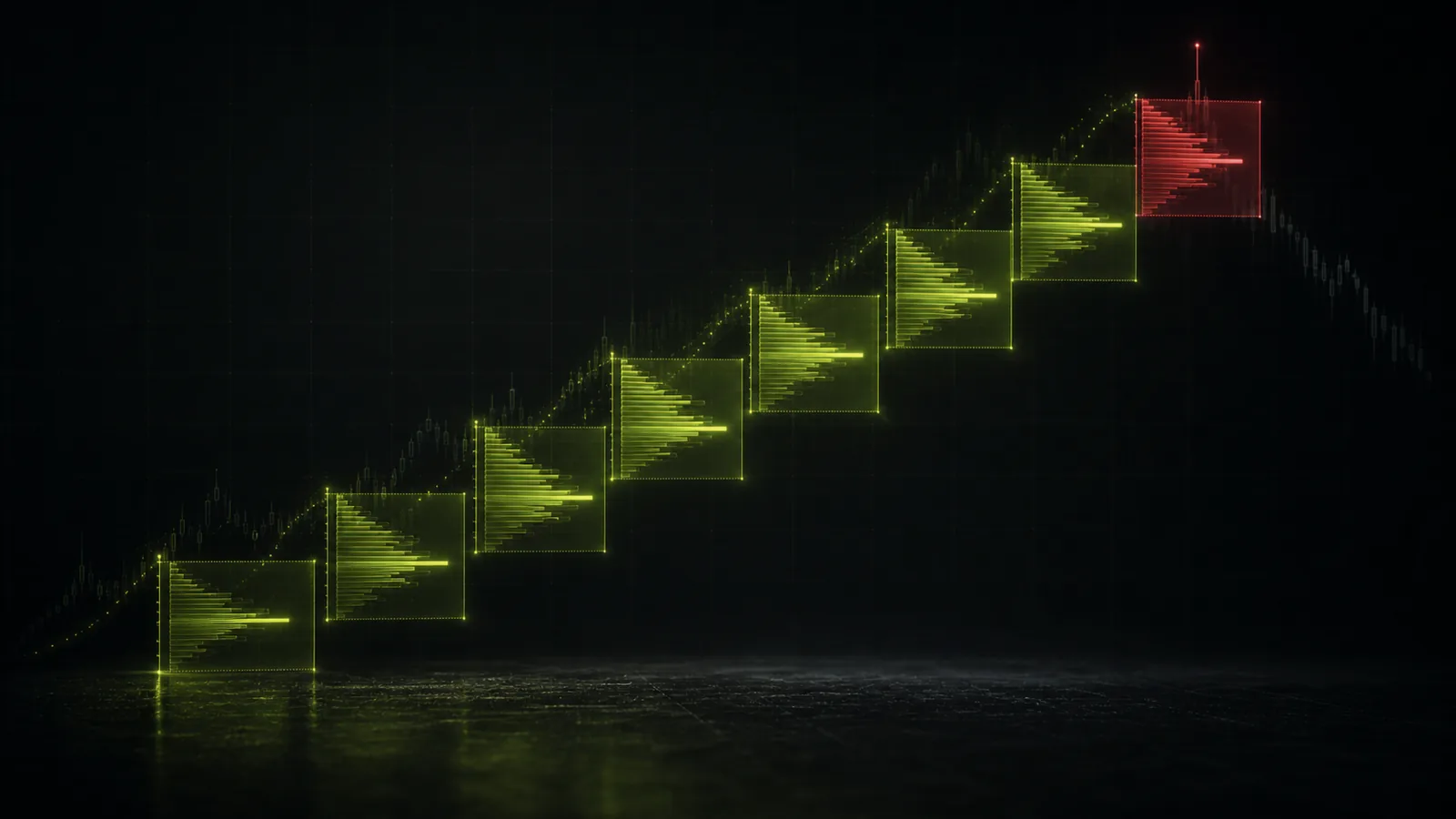
Value-area migration is the session-to-session drift of the value area, the roughly 70 percent volume range and its point of control, as the market accepts business at new prices. Migration up means each session is doing its trade higher than the last; an auction failure is when price probes beyond value but finds no acceptance and rotates back, stalling the migration.

Target audience: Traders comfortable with a single-session volume profile who want to read multi-day context and distinguish trend continuation from a failing auction.

Learning objectives

  • Track the point of control and value-area edges across consecutive sessions
  • Classify a sequence as migrating, balancing, or failing
  • Define acceptance versus rejection beyond the value area
  • Use a failed auction back into value as a fade or reversal signal with defined risk

Definition

Value-area migration is the session-to-session drift of the value area, the roughly 70 percent volume range and its point of control, as the market accepts business at new prices. Migration up means each session is doing its trade higher than the last; an auction failure is when price probes beyond value but finds no acceptance and rotates back, stalling the migration.

Why it matters

A single day's profile tells you where value was; a sequence of profiles tells you where value is going. Tracking the point of control and value-area edges across days turns a pile of candles into a directional story: are buyers paying up and holding, or is every push above value being rejected? Knowing whether value is migrating or stuck is the difference between trading with the auction and fighting it.

Value is a range, not a line

Each session builds a value area: the contiguous band of prices, centered on the point of control, that held about 70 percent of the day's volume, bounded by the value-area high and value-area low. Reading one session in isolation answers where the market agreed today. The information you actually trade on appears when you line up several sessions and watch how that band moves.

Migration: value that walks in one direction

When each session's point of control prints higher than the last and the value areas overlap only at their edges, value is migrating up. The market is accepting business at progressively higher prices, which is the profile signature of a healthy uptrend. The overlap matters: completely separate value areas signal a violent, often unsustainable gap, while smoothly overlapping, upward-stepping value is the orderly migration that tends to continue.

Acceptance versus rejection

Acceptance means price trades beyond the prior value area and stays, building fresh volume there so the next session's value area forms higher. Rejection means price probes beyond value, finds no business, and snaps back inside, leaving a thin single-print tail. The whole game above value is this question: did the probe build volume, which is acceptance and continuation, or did it leave a tail, which is rejection and a likely return to the point of control.

Auction failure: the migration stalls

An auction fails when price pushes above the developing value-area high, makes a marginal new high, and then cannot trade there: volume dries up, the probe leaves a tail, and price rotates back toward the point of control. After several sessions of clean upward migration, a failed auction is the first objective sign that buyers have stopped paying up. It does not by itself mean reverse; it means the easy continuation trade is over and the balance or pullback trade is now on the table.

Trading the read

While value migrates cleanly, the bias is to buy pullbacks into the rising value area and lean on the point of control as support. When an auction fails above value, the trade flips: a probe above the value-area high that gets rejected back inside is a fade toward the point of control, with invalidation on acceptance, that is, price building volume above the high rather than tailing away from it.

Visual models

Value-area migration: the point of control drifts up session by session, then the auction fails above VAH
Value-area migration ladderFour session value areas: the point of control migrates higher across the first three sessions, then a probe above the value-area high finds no acceptance and rotates back to the point of control.44904505452045354550POC 4505Day 1POC 4520Day 2POC 4535Day 3POC 4535Day 4no acceptance 4548Value migrates up, then stallsPOC 4505 to 4535 accepted; the probe above 4545 fails.pricesessions
Volume profile: POC, value area, high-volume acceptance and low-volume rejection
Volume profile chartA horizontal volume-by-price distribution highlights the point of control, the seventy percent value area between VAH and VAL, high-volume nodes, and low-volume nodes.0375750112515004545.00904540.001504535.005404530.009004525.001,1804520.001,5004515.001,1604510.008204505.005404500.001504495.0080VAH 4530VAL 4510POC 4520~70% volume in valuePOCHVNLVNpricevolume traded at price

Worked examples

Example 1: Three sessions of clean migration

Over three ES sessions the point of control prints at 4505, then 4520, then 4535, with each value area (VAL to VAH of 4495 to 4515, 4510 to 4530, 4525 to 4545) overlapping the previous one at its edge. Value is migrating up in orderly 15-point steps, business is being accepted higher each day, and the read is to keep buying pullbacks into the rising value area rather than fading strength.

Example 2: The auction that failed

On the fourth session price pushes to 4548, just above the developing value-area high of 4545, but volume there collapses and price rotates straight back to the point of control at 4535, leaving a single-print tail above 4545. The migration has stalled: the probe was rejected, not accepted. The trade is to fade the next failed push above 4545 back toward 4535, with a stop above 4548 and the thesis invalidated only if price builds real volume above the high.

Common mistakes

Reading one session's profile in isolation and missing the multi-day drift

Confusing a marginal new high with acceptance before any volume builds there

Fading every probe above value instead of waiting for the rejection tail to confirm

Ignoring whether value areas overlap, which separates orderly migration from a fragile gap

Calling a single failed auction a trend reversal rather than a stalled continuation

Myth vs reality

Myth

That a new high is the same thing as acceptance; without volume it is just a probe

Reality

No paired reality note provided.

Myth

That migration must continue every session; auctions balance and fail regularly

Reality

No paired reality note provided.

Myth

That a failed auction guarantees a reversal rather than merely ending the easy trend trade

Reality

No paired reality note provided.

Strengths and weaknesses

Strengths

  • stacking profiles gives an objective, repeatable read on trend health
  • acceptance versus rejection is a clear, testable distinction for entries

Weaknesses

  • it needs several sessions to form a read, so it is slow to update intraday
  • value-area construction varies with the volume window chosen, so settings matter

Risk considerations

  • Migration can reverse on news regardless of how clean the prior drift looked
  • A tail can fill on a later session, turning prior rejection into acceptance, so manage stops
  • Overlapping value can widen into a violent gap; do not assume orderly steps will persist

Practice exercises

1. Stack three sessions and label the drift

Build volume profiles for three consecutive sessions, mark each point of control and value-area edge, and label the sequence as migrating, balancing, or failing.

  1. Draw a volume profile for each of three consecutive sessions
  2. Mark the point of control and the value-area high and low on each
  3. Note whether the value areas step in one direction and overlap or stay flat
  4. Find one probe beyond value and label it acceptance or rejection by whether volume built there

Quiz

Q1. What is value-area migration?

Q2. How do you tell acceptance from rejection above value?

Q3. What is an auction failure?

Q4. Does a failed auction mean reverse and sell?

Next lesson

Absorption and Exhaustion: When Aggressive Orders Fail

This lesson is educational content only and is not financial advice. Order-flow tools describe past auction behavior; they do not predict the future or guarantee any outcome. Trade only with risk you can afford to lose.